
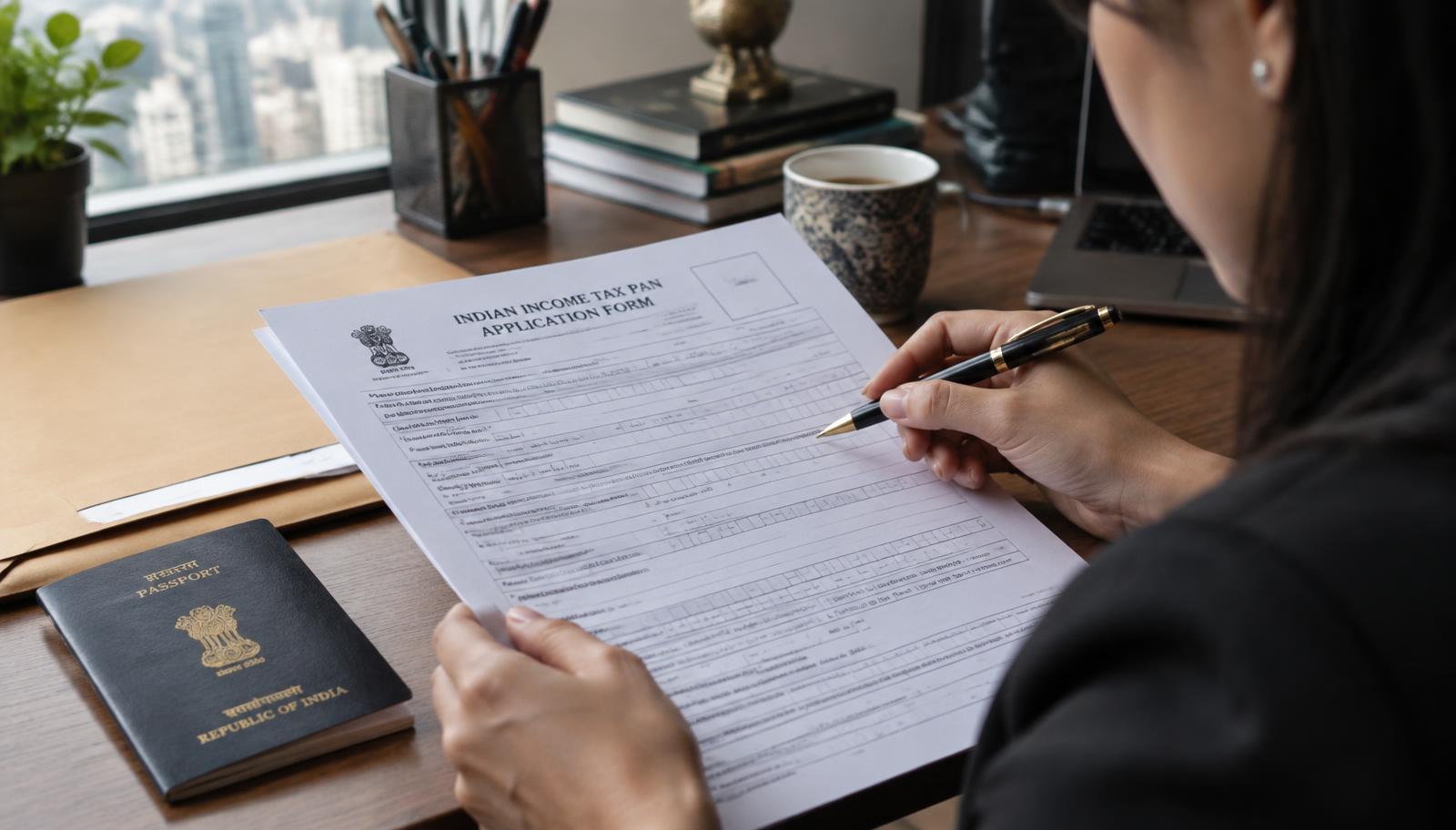
A PAN is the ten-character taxpayer number issued by India's Income Tax Department. You need one to receive Indian income at the normal withholding rate, to become a director of an Indian company, to invest, or to deal in Indian property. Thai and other foreign nationals apply on Form 49AA; Indian citizens living in Thailand use Form 49A. Both can be filed online from Thailand through the department's appointed agencies, Protean (formerly NSDL e-Gov) and UTIITSL. Most delays from Thailand come from copies that were not attested through an accepted route and from names spelled differently across documents.
Last reviewed: 2026-10-04 · General information only, not legal advice for your specific case
What a PAN is and why people in Thailand end up needing one
A Permanent Account Number stays with one person or entity for life. It does not change when you move and does not expire. The Income Tax Department uses it to tie together a taxpayer's income, tax deducted at source and high-value transactions, and Indian law prohibits holding more than one.
The people who ask us about a PAN from Thailand usually fall into three groups. Thai residents paid by Indian clients for consulting, royalties or dividends find that, without a PAN, the Indian payer often has to withhold tax at a higher rate. Foreign or Thai investors joining an Indian company as director or shareholder need a PAN before they can obtain a Director Identification Number. And Indian nationals working in Thailand keep bank accounts, mutual funds or land at home that require an active PAN.
A PAN is not Aadhaar. Aadhaar is an identity number for residents of India; foreigners living abroad generally do not have one and can still obtain a PAN. The PAN–Aadhaar linking requirement carries exemptions for non-residents, so check your own status on the Income Tax e-Filing portal rather than assuming a rule written for residents applies to you.
Choosing the right form: 49A or 49AA
The test is the nationality on the passport you hold on the day you apply, not ancestry or birthplace. People of Indian origin who have become Thai citizens regularly file Form 49A by mistake and have to start again.
| Applicant | Form | Main identity document |
|---|---|---|
| Thai or other foreign national | 49AA | Passport (or OCI/PIO card for persons of Indian origin) |
| Indian citizen living in Thailand | 49A | Indian passport |
| Thai company with Indian income or investment | 49AA | DBD company certificate with certified English translation |
| Existing PAN holder updating details | Change/correction request | Evidence of the new details, e.g. renewed passport |
Documents an applicant in Thailand should prepare
- Proof of identity: a copy of the data page of a valid passport.
- Proof of address: a Thai address is acceptable, evidenced by a document from the list in the current form instructions, such as a recent Thai bank statement or a residence certificate.
- Photographs and signature in the size and format the agency specifies for paper or digital filing.
- For entities: certificate of registration and evidence of the authorised signatory, with certified English translations.
- An Indian contact address and representative, if you want the card delivered in India.
Attestation: where Thai applications are most often rejected
The PAN agencies accept foreign document copies attested through specified channels, typically an Indian embassy or consulate in the country of residence, an apostille, or an overseas branch of a listed Indian bank. Read the instructions attached to the current version of the form before you prepare anything, because the accepted list is revised from time to time.
Thailand needs particular care on the apostille point. Thailand deposited its accession to the Apostille Convention on 30 June 2026 and the Convention enters into force for Thailand on 28 February 2027. Until then Thai authorities cannot issue apostilles, so the workable route for Thai documents is attestation through the Embassy of India in Bangkok, sometimes after legalisation by the Department of Consular Affairs at the Ministry of Foreign Affairs.
We prepare certified English translations of Thai documents and assemble the file in the order the embassy expects, so it is accepted on the first visit rather than after several rounds of corrections.
Step-by-step: applying from Thailand
1. Check whether you already have a PAN
Anyone who once worked, invested or opened an account in India may already hold one. A second PAN is unlawful, so search old records or use the verification service on the e-Filing portal first.
2. Pick the agency and the form
File online with Protean or UTIITSL, using Form 49AA as a foreign national or 49A as an Indian citizen.
3. Match your passport exactly
Given names, surname and date of birth must match the passport letter for letter, including name order. Some cases require the father's name as set out in the form.
4. Attest and submit documents
Have copies attested through an accepted route, then upload or post them as the agency instructs within its deadline.
5. Pay and track
The fee for an overseas dispatch address differs from an Indian one. Pay online and track progress with the 15-digit acknowledgement number.
6. Receive the e-PAN and card
The e-PAN arrives as a PDF by email and is accepted for many purposes; the physical card follows by post, which takes longer to reach Thailand than an Indian address.
What you can do once the PAN is issued
- Give it to Indian payers so tax is deducted at the correct rate, and claim India–Thailand tax treaty rates with the supporting documents.
- Open NRO/NRE accounts as a non-resident Indian, or accounts available to foreign nationals under Reserve Bank of India rules.
- Apply for a Director Identification Number to join an Indian company board.
- Deal in Indian property where the law allows, and file an Indian income tax return.
- Invest in securities and funds through channels open to foreign investors.
The Thai side of the same income
Indian income brought into Thailand by a Thai tax resident may also have to be reported in Thailand under the Revenue Department's rules on foreign-sourced income. Tax withheld in India can often be credited under the double tax agreement, but only with withholding certificates issued against the recipient's PAN.
Claiming treaty rates in India usually requires a Thai Certificate of Residence from the Revenue Department together with the forms India specifies. We coordinate that document set and hand it to the accountant who handles your tax position.
Mistakes that delay a PAN or produce wrong data
- Using the wrong form for your nationality.
- Sending self-certified copies instead of copies attested by an accepted authority.
- Romanising a Thai name differently from the passport.
- Giving an address you cannot evidence, or an incomplete international dispatch address.
- Applying for a new PAN instead of correcting an existing one.
What we do and where our role ends
We confirm the correct form, translate and certify Thai documents, coordinate Ministry of Foreign Affairs and Indian Embassy attestation, and review the application before submission to reduce the chance of rejection.
PAN allotment is decided solely by India's Income Tax Department. We are not affiliated with the Government of India or the PAN agencies and cannot commit to processing times. Tax remarks on this page are general; take advice from an accountant or tax adviser for your own case.
Frequently asked questions
Can a Thai citizen get an Indian PAN card?
Yes. Foreign nationals, including Thais, apply on Form 49AA using their passport as identity proof, and can file from Thailand.
Do I need Aadhaar before applying for a PAN?
Foreign nationals not resident in India generally do not need Aadhaar to obtain a PAN. Confirm current rules on the e-Filing portal.
Can Thai documents be apostilled for a PAN application?
The Apostille Convention takes effect for Thailand on 28 February 2027. Until then, use attestation by the Embassy of India as accepted by the PAN agencies.
Is the e-PAN as valid as the physical card?
The e-PAN is issued by the Income Tax Department and is accepted for many transactions, though some institutions still ask to see the card.
What if I have forgotten my old PAN?
Do not apply again. Retrieve the existing number via the e-Filing portal or old records, then file a correction if your details have changed.
Official sources
Related services
Get your PAN application right the first time
Tell us your nationality and purpose; we will confirm the form, documents and attestation route that work for your case.
Contact the team