
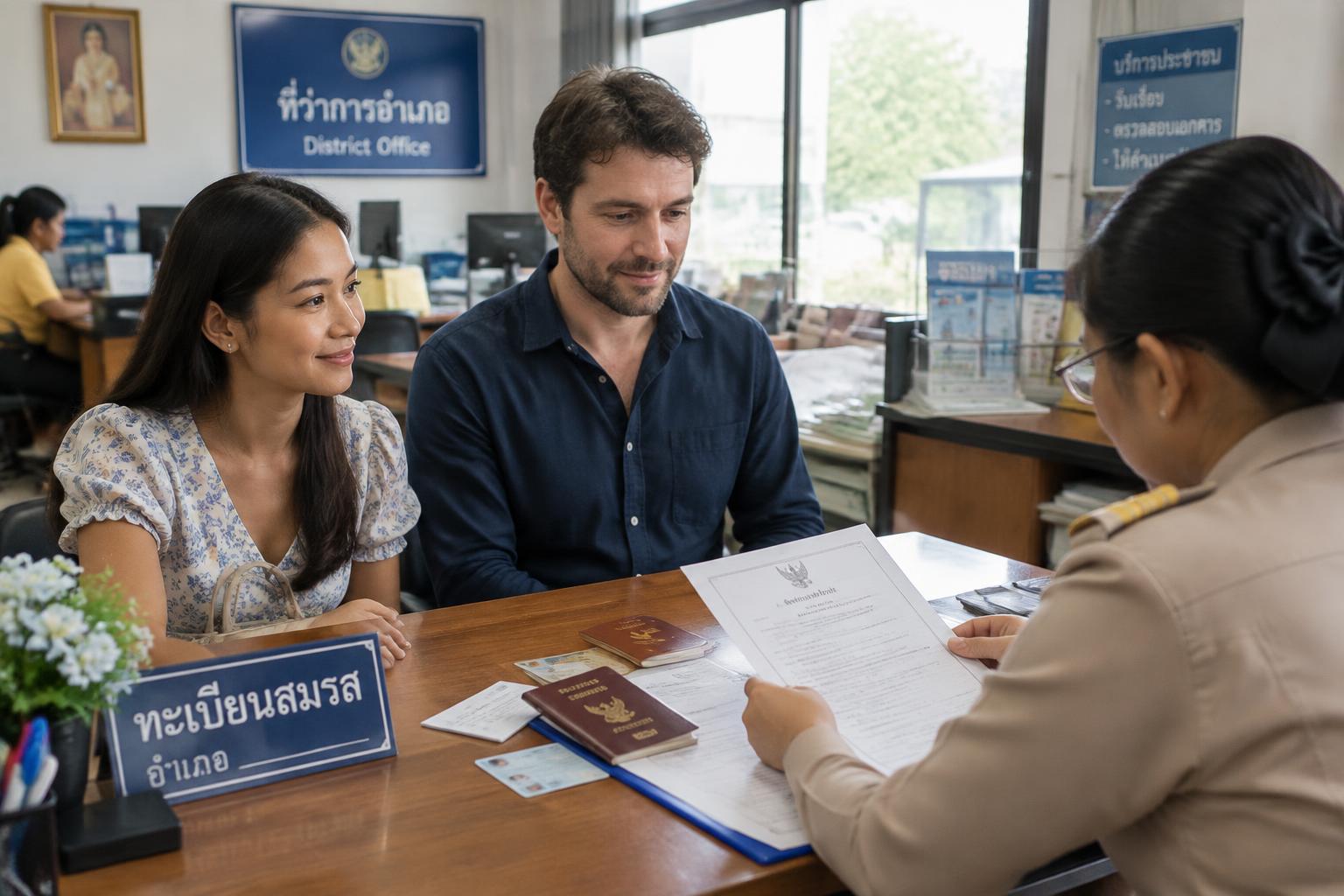
A marriage between a Thai national and a foreigner can be registered at any district office (amphoe) or Bangkok district office nationwide, but the foreign partner must first obtain an affirmation of freedom to marry from their own embassy in Bangkok, have it translated into Thai, and have both legalised at the Consular Affairs Department of the Ministry of Foreign Affairs. The Thai partner needs their ID card and house registration; anyone previously married must prove the earlier marriage has ended. With a complete document set, registration itself is quick and you receive the marriage register entry (Kor Ror 22) and marriage certificate (Kor Ror 3) the same day. We check documents, arrange certified translation, and coordinate the legalisation chain before your appointment — the registration decision itself rests solely with the registrar.
Last reviewed: 2026-10-04 · General information only, not legal advice for your specific case
Who this page is for
This page is written for Thai-foreign couples planning to register their marriage in Thailand, whether you intend to stay in Thailand or relocate to the other partner's country. It also covers couples where one partner was previously married and must prepare divorce or widowhood evidence correctly, and couples who need the Thai marriage certificate for a dependent visa or nationality matters abroad.
The most common mistake we see in cross-border marriage cases is arriving at the district office with an affirmation of freedom to marry that has not yet been translated and legalised at the Ministry of Foreign Affairs, or one that has expired, because most district offices only accept documents issued within a set period. Getting the sequence right from the start saves several repeat trips across Bangkok.
Embassy procedures differ considerably. Some embassies let you swear the affirmation in front of a consular officer on the day; others require you to first obtain a certificate of no impediment from your home country's registry, which can take weeks. Checking your own embassy's current procedure is always the genuine first step, not the district office visit.
What each partner must prepare
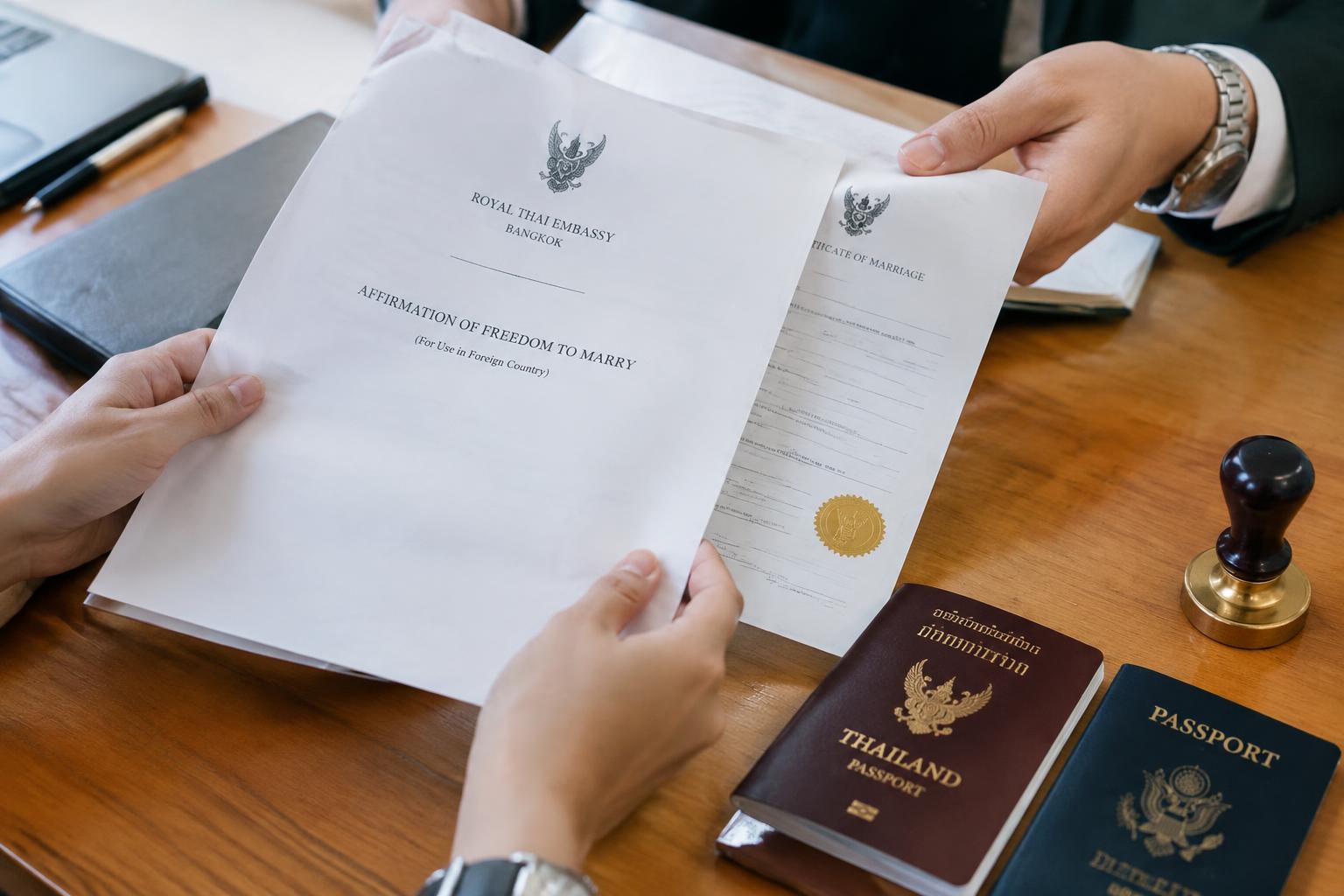
The foreign partner needs an affirmation of freedom to marry. Each embassy in Bangkok runs this differently: some issue it after an in-person sworn statement, others require registry documents from the home country first. Once issued, the letter must be translated into Thai and both the original and the translation legalised at the Consular Affairs Department of the Ministry of Foreign Affairs.
The Thai partner needs their national ID card and house registration. Anyone previously married must show the marriage has legally ended: a divorce register entry (Kor Ror 6), the former spouse's death certificate, or a court judgment. A foreign divorce must be registered in Thailand before a new marriage can be recorded.
- The foreign partner's passport (original and copy of the data page)
- Embassy affirmation of freedom to marry, with its certified Thai translation
- The Thai partner's national ID card and house registration
- Evidence any previous marriage has ended: divorce entry, death certificate, or court judgment, with certified translations
- Spare copies of everything, since the district office keeps what you hand over
The registration process step by step
1. Obtain the affirmation from the embassy
Contact the foreign partner's embassy in Bangkok. Procedures and waiting times differ; some require an appointment booked well in advance.
2. Translate into Thai
Have the affirmation and all supporting documents translated into Thai by a translator the Consular Affairs Department accepts.
3. Legalise at the Consular Affairs Department
Submit originals and translations for signature legalisation at the Ministry of Foreign Affairs. Processing takes several working days depending on the queue.
4. Check the full document set
Verify that names, dates of birth, and document validity dates are consistent across every paper before the registration appointment.
5. Register at the district office
Both partners attend together with the complete set. The registrar reviews the documents and records the marriage; you receive the Kor Ror 22 register entry and Kor Ror 3 certificate.
6. Legalise the certificate for use abroad (if needed)
To use the Thai marriage certificate for a visa or to record the marriage in another country, have it translated into English and legalised at the Ministry of Foreign Affairs again.
After registration: using the Thai certificate abroad
A Thai marriage certificate is a Thai-language document that other countries cannot read or accept directly. For a spouse visa application, a nationality filing, or recording the marriage in the foreign partner's country, it must be translated into English (or that country's language) and legalised at Thailand's Ministry of Foreign Affairs. Some countries then require further legalisation at their own embassy in Bangkok.
Countries in the Apostille Convention may accept an apostille instead of embassy legalisation, but Thailand can only issue apostilles once the convention enters into force for Thailand on 28 February 2027. Until then, the embassy legalisation route remains the only option.
For the foreign partner's stay in Thailand — for example a Non-Immigrant O visa based on marriage, or an extension of stay — the immigration bureau looks at the marriage certificate together with financial evidence and proof of living together. Preparing a consistent document set from the start reduces requests for additional evidence.
Prenuptial agreements and property
Under Thai law a prenuptial agreement must be made in writing and registered together with the marriage — it cannot be added afterwards. Couples with assets in several countries should take advice from lawyers in both jurisdictions, because an agreement that is valid in Thailand may have limited effect abroad, and vice versa.
The question we hear most is about land ownership. Thai law generally does not allow a foreigner to own land, even after marrying a Thai national. Structuring property is a matter for direct legal advice, not something a single document can arrange.
What we handle, and what belongs to authorities or lawyers
We check the document set before your appointment, arrange certified translation of the affirmation and supporting papers, coordinate legalisation at the Consular Affairs Department, and prepare the translated certificate package for use abroad after registration. For couples who want an interpreter on the registration day, we can send one along.
Marriage registration is the registrar's authority at the district office. Issuing the affirmation is each embassy's authority. Advice on prenuptial agreements or property structures is work for licensed lawyers. We work alongside those specialists and can introduce suitable firms where needed.
Frequently asked questions
How long does international marriage registration take?
With a complete, legalised document set, the registration itself at the district office is done the same day. The preparation — obtaining the affirmation, translation, and consular legalisation — typically takes one to two weeks depending on the embassy and legalisation queues.
How long is the affirmation of freedom to marry valid?
Most district offices accept letters issued within roughly three to six months, varying by office. Plan so that consular legalisation and the registration date fall within the document's validity window.
What if I divorced abroad?
The divorce evidence or judgment must be translated and legalised, and the Thai partner must register the divorce in Thailand first. Until the earlier marriage is ended in the Thai registers, a new marriage cannot be recorded.
Can the Thai marriage certificate be used in other countries directly?
Not directly. It must be translated into English or the destination country's language and legalised at Thailand's Ministry of Foreign Affairs; some countries also require legalisation at their embassy in Bangkok. After Thailand's apostille system begins (28 February 2027), convention member countries may accept an apostille instead.
Does marriage give the foreign partner Thai nationality or land ownership rights?
No. Marriage does not automatically grant Thai nationality or the right to own land. Nationality applications are a separate process, and Thai law generally prohibits foreign land ownership. These matters need direct legal advice.
Are witnesses required on the registration day?
Thai marriage registration generally does not require witnesses, but some offices may ask for additional supporting persons or documents at their discretion. Check with the specific district office in advance.
Official sources
Related services
Start by sending the basics
Tell us about your situation and what you need checked. We will reply with the documents and steps that apply to your case.
Contact the team