
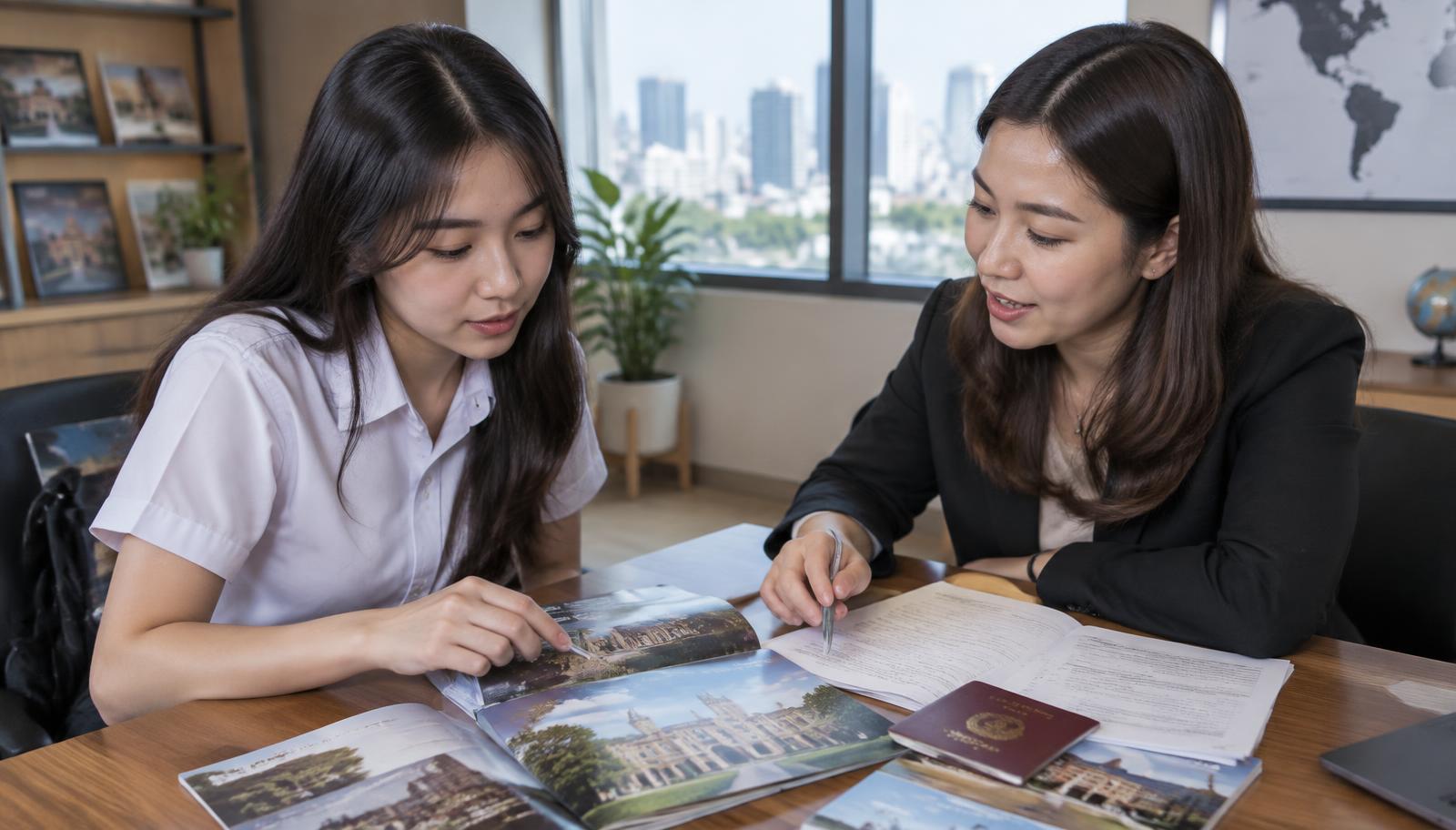
A student visa application from Thailand stands on three things: an offer or confirmation of enrolment from an approved institution, proof that the student can pay tuition and living costs, and documents the visa officer can read and verify. Thai transcripts, house registration, birth certificates and parents' bank and employment letters usually need certified English translations. Some schools or countries also ask for notarisation or legalisation. Each destination sets its own rules — the CoE and Genuine Student requirement in Australia, the CAS in the UK, the I-20 and interview in the US, the provincial attestation letter in Canada — so the file must be built for the destination, not copied from a friend's.
Last reviewed: 2026-10-04 · General information only, not legal advice for your specific case
Who this guide is for
We wrote this page for three groups we regularly help. Thai students and their parents preparing a first application abroad. Expatriate families in Thailand whose children studied at Thai or international schools and now apply to universities overseas. And mature students — often professionals in their thirties — returning to study for a master's degree with family members joining them.
Each group runs into different document problems. Thai students need translations of Thai-language records. International school students usually have English transcripts but may be asked for police certificates or proof of residence in Thailand. Mature students need to show employment history, a career plan that makes sense, and funds that cover dependants.
What each major destination asks for
Requirements change often, especially financial thresholds and caps on international student numbers. We check the destination's official immigration website each time we prepare a file, and we cite the version used. We do not rely on figures from last year's applicants.
| Destination | Key admission document | Visa points that often cause problems |
|---|---|---|
| Australia | Confirmation of Enrolment (CoE) | Genuine Student requirement, evidence of funds, Overseas Student Health Cover for the full stay |
| United Kingdom | Confirmation of Acceptance for Studies (CAS) | Funds held for the required period before applying, TB test certificate, English language evidence |
| United States | Form I-20 (F-1) or DS-2019 (J-1) | SEVIS fee, DS-160, embassy interview, showing ties to home |
| Canada | Letter of acceptance and provincial attestation letter where required | Proof of funds, biometrics, study plan |
| New Zealand | Offer of place | Funds, medical and chest X-ray where required, insurance |
Thai documents that usually need translating
- School and university transcripts and certificates (Por Por 1 or Ror Bor, and degree certificates).
- Birth certificate, house registration (Tabien Baan) and Thai ID card, which show the family relationship to a sponsoring parent.
- Name-change certificates, where the name on the passport differs from older records.
- Parents' employment letters, salary slips, business registration and tax documents, which show where the money comes from.
- Bank statements and bank letters. Many banks issue English letters, but older statements may need translating.
- Marriage certificate and children's birth certificates when dependants apply.
- Police clearance certificate from the Royal Thai Police, where the destination or the course requires one.

What makes a translation acceptable
Most immigration authorities accept a complete English translation with a statement from the translator confirming that it is accurate, together with the translator's name, contact details and signature. Australia asks for translations by NAATI-certified translators when the translation is done in Australia; for translations done outside Australia, it expects the translator's full name, address, telephone number and qualifications. The UK asks for the translator's credentials, a confirmation that the translation is accurate, the date, and the translator's signature and contact details.
Some universities, particularly for professional programmes, want transcripts sent directly by the issuing institution or attested by a notary. We confirm each school's instruction before translating, so the student does not pay twice.
How we prepare a student file
1. Review the offer and destination rules
We read the offer conditions and the current visa guidance, then send a checklist specific to that student, course and country.
2. Collect and check originals
We compare names, dates of birth and document numbers across every record and flag inconsistencies before translation.
3. Translate and certify
Translations are prepared by qualified translators, with NAATI-certified translators for Australian applications where needed, and notarisation or legalisation added where the school or authority asks for it.
4. Financial evidence check
We check that bank balances, the holding period and the sponsor's relationship evidence meet the destination's rules on the date of application.
5. Submission support
We guide the student through the online application, biometrics or interview booking, and prepare answers grounded in the documents actually filed.
Work and Holiday and Au Pair programmes
Thailand has Work and Holiday arrangements with Australia (subclass 462) and New Zealand, among others. Each has an annual quota, an age limit, educational and English requirements, and a minimum level of funds. The Australian 462 for Thai nationals also requires a letter of government support. Places are limited and open in short windows, so documents should be ready and translated in advance.
Au Pair programmes in Europe and the United States are run through approved agencies and host families, under visas specific to each country. We prepare and translate the personal documents these programmes ask for, such as police certificates, medical certificates and education records. We do not act as the placement agency or choose the host family.
What we do not promise
A visa decision belongs to the destination government. Our role is to make sure the file is complete, consistent and properly translated, and that the student understands what is being submitted. We do not prepare statements that misrepresent the student's intentions or finances. Refusals for misrepresentation can affect future applications to the same country, and sometimes to others.
A realistic timeline for preparing documents
Most delays in student visa applications come from documents, not from the visa decision itself. Thai civil documents such as birth certificates, house registration extracts and name-change certificates are issued in Thai, so they usually need a certified English translation. Some destinations also ask for the translation to be legalised by the Department of Consular Affairs at the Ministry of Foreign Affairs, or for the original to be notarised. Each step adds working days, so it helps to plan backwards from the visa appointment.
Academic records follow a different path. Transcripts and degree certificates normally come from the school or university registrar, often in English already, and many universities abroad want them sent directly by the issuing institution or verified through a recognised credential service. Check the admissions instructions before translating or certifying anything yourself, because a self-arranged copy may not be accepted.
Financial documents are the part that changes most. Bank statements and sponsor letters often need to be recent, typically within a stated number of days before the application, and must show funds that meet the destination's published minimum. Prepare these last, after the other documents are ready, and confirm the current figure on the official immigration website rather than relying on an older checklist.
- 8 to 12 weeks before: confirm the destination's document list and translation rules.
- 6 to 8 weeks before: order civil document translations and any consular legalisation.
- 3 to 4 weeks before: request transcripts through the registrar or credential service.
- 1 to 2 weeks before: obtain current bank statements and sponsor letters.
Frequently asked questions
Do I need NAATI translations for an Australian student visa?
If the translation is done in Australia, it should be by a NAATI-certified translator. Translations made outside Australia must include the translator's full details and qualifications. Using a NAATI-certified translator is the simplest way to meet both standards.
Do my Thai transcripts need an apostille?
Usually not for visas. Some universities ask for notarised or legalised copies. Note that Thailand's accession to the Apostille Convention enters into force on 28 February 2027; until then, documents go through MFA legalisation where legalisation is required.
Can my parents sponsor me with funds from their business?
Yes, generally, provided you can show the relationship and the source of funds. That usually means business registration, tax filings and bank records, translated into English.
Can you help international school students in Thailand?
Yes. We help with Thai police certificates, proof of residence and translations of any Thai-language records, and with legalising documents where a university asks for it.
Can my spouse and children come with me?
Many destinations allow dependants for certain courses, usually postgraduate study, but rules have tightened in several countries. We check the current rules for your course before you apply.
Official sources
Related services
Send us your offer letter and destination
Share your offer or the courses you are applying to, the destination, and who will sponsor your studies. We will reply with a document checklist and the translations you need.
Contact the team