
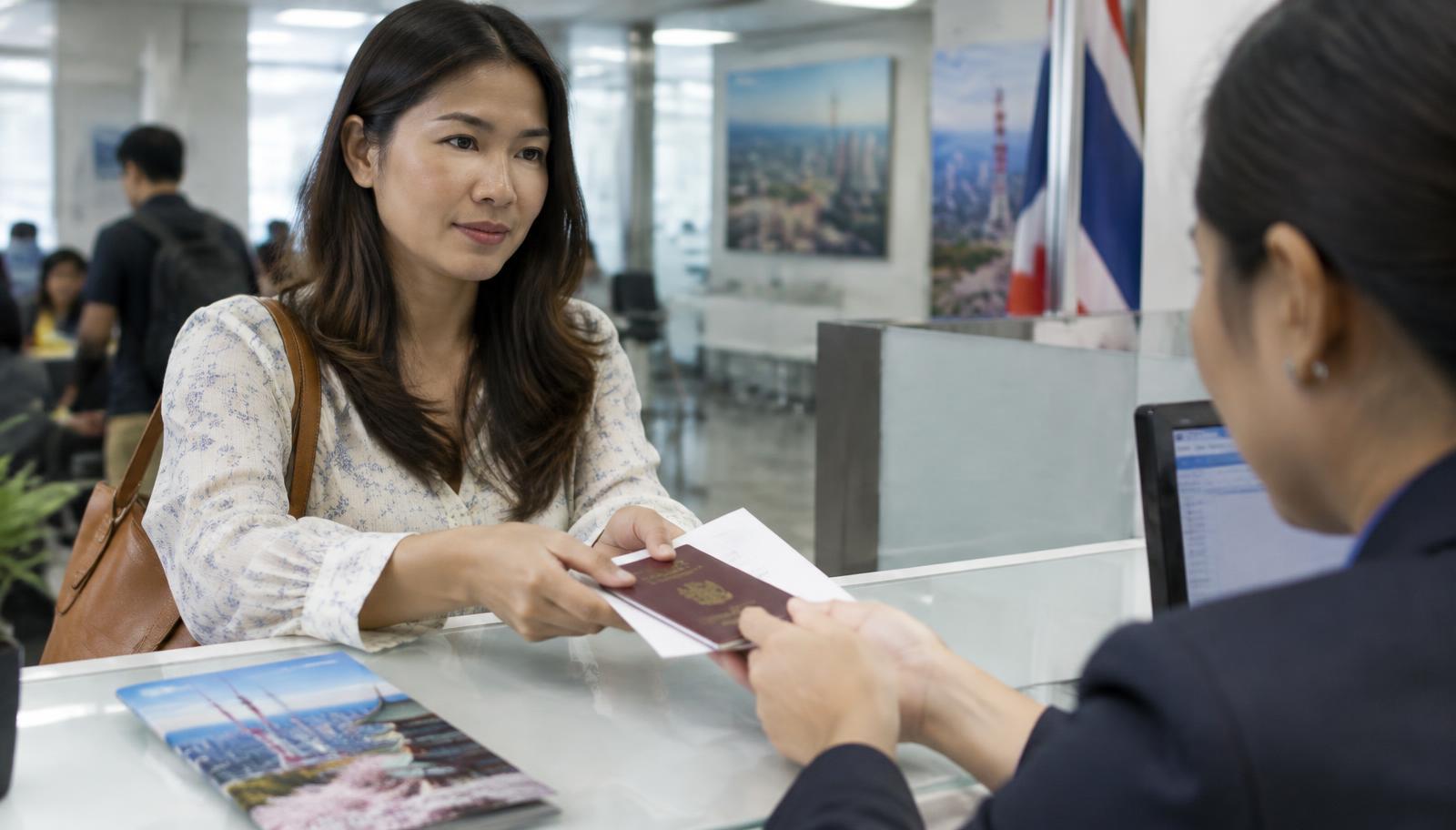
Thai ordinary passport holders are eligible for South Korea's visa waiver for short visits of up to 90 days, but travellers using it must obtain an approved K-ETA (Korea Electronic Travel Authorization) online before boarding, unless the Korean government has announced a temporary exemption. If K-ETA is refused, or if the purpose is work, study or a stay longer than 90 days, a visa must be applied for through the Embassy of the Republic of Korea or the application centre it designates.
Last reviewed: 2026-10-04 · General information only, not legal advice for your specific case
K-ETA is not a visa: understanding the two routes
K-ETA is an electronic pre-travel authorization for visa-waiver nationals. Applicants submit personal, employment and itinerary details through the official K-ETA website or app and receive the result by email. An approval can be used for multiple trips during its validity, but it does not assure entry: the immigration officer at the border makes the final decision.
The short-term C-3 visa is examined by the embassy on the basis of actual documents. It suits travellers whose K-ETA was refused, those who prefer to present evidence before travelling, and purposes that need an invitation letter. It takes longer and requires more paperwork, but it lets the applicant demonstrate ties to Thailand in a structured way.
Work, study, joining a spouse or staying beyond 90 days cannot be done on K-ETA. The applicant needs the long-term visa matching the activity, such as D-2 for degree students, E-9 for workers under the Employment Permit System, or F-6 for spouses of Korean nationals.
Korea has announced temporary K-ETA exemptions for certain countries at certain times. Always check the official K-ETA site and the Korean Embassy in Thailand before booking, rather than relying on undated social media posts.
Why many Thai K-ETA applications are refused, and what to do next
The K-ETA system does not give individual reasons. Factors commonly involved include unclear employment or income information, implausible accommodation or itinerary details, limited travel history and the authorities' assessment of overstay or unauthorised work risk.
Resubmitting immediately with the same information rarely helps. After a refusal, the more appropriate route is usually a C-3 visa application at the embassy, where employment, financial and itinerary evidence can be presented on paper.
Anyone previously refused entry at a Korean airport or with an overstay record should get case-specific advice before reapplying, because that history is considered every time.
- Enter names and passport numbers exactly as printed
- State your real employer and position, consistent with your employment letter
- Use accommodation and an itinerary that match your approved leave
- Avoid any service claiming it can make K-ETA succeed; nobody controls the outcome
C-3 visa documents and the points most often queried
Requirements vary by occupation and purpose, so the embassy's current checklist should always be the reference. Documents generally fall into identity, employment, financial and travel groups.
- Passport with sufficient validity, application form and photo to specification
- English employment letter stating position, salary, length of service and leave dates, or company registration for business owners
- Bank statements for the period the embassy requires, with a bank certificate
- Students: certificate of enrolment and evidence from the parent covering costs
- Invitation letter and the inviter's documents in Korea for family or business visits
- House registration, ID card and any change-of-name certificate, with English translations
Long-term visas Thais commonly apply for: study, work and marriage
Korean language students (D-4) and degree students (D-2) need an admission letter from a Korean institution, financial evidence and academic records translated and certified as the embassy requires. Some institutions ask for degrees to be authenticated by Thailand's Department of Consular Affairs first.
Thai workers under the EPS go through a government-to-government channel supervised by Thailand's Department of Employment. Applicants should deal with that department directly and be wary of brokers offering work in Korea on K-ETA or a tourist visa, which is illegal under Korean law and can lead to an entry ban.
Spouses of Korean nationals (F-6) must have a marriage valid in both Thailand and Korea, translated and certified civil status documents, and a Korean spouse who meets the Ministry of Justice criteria.
At a Korean airport: how to prepare for questions
Even with K-ETA or a visa, officers may ask about purpose, accommodation, duration and funds. Carry copies of your booking, return ticket and Thai employment evidence, and make sure your answers match what you declared.
Group and family travellers should know their own accommodation and plans even if someone else booked them, as officers may question people separately. A child travelling with one parent should carry the other parent's consent letter with a translation.
Timing: how early to apply for K-ETA or a visa
A common situation is booking a promotional fare first and applying for K-ETA only days before departure. If it is refused, there is no time left for a C-3 visa, which requires an appointment and the embassy's published processing time. It is safer to apply for K-ETA before paying for tickets that cannot be cancelled and to leave room for a fallback.
Travellers who know they have risk factors, such as freelancing without an employer letter, a recent job change or no previous international travel, may prefer to apply for a C-3 visa from the outset, because documents explain their situation more fully than an online form.
Students and workers must start much earlier, since they depend on documents from Korean institutions or employers, and some Thai documents must be translated and certified by the Department of Consular Affairs, which has its own queues and processing times.
Freelancers, business owners and applicants without a salary
Applicants without an employer cannot provide a standard employment letter, so they should show continuous income instead: company or commercial registration, VAT registration, personal income tax filings, client contracts and bank statements showing regular receipts.
Homemakers, retirees and students supported by someone else should attach proof of the relationship, such as translated marriage or birth certificates or house registration, together with the sponsor's income documents. A sponsorship letter should name the traveller, state the travel dates and be clearly signed.
In every case a short English cover letter explaining the purpose, who pays and what the applicant will return to in Thailand helps the officer understand the file quickly. It must match the attached evidence and never overstate anything that cannot be proved.
Translating Thai documents for Korean applications
Translations must reproduce names exactly as in the passport, including the romanisation used there, because a different spelling of the same name across the employment letter, bank certificate and house registration is one of the most frequent reasons officers ask for clarification.
For short visits, embassies usually accept clear English translations of Thai documents. For long-term purposes such as study, marriage registration or employment, Korean authorities may require translations certified by Thailand's Department of Consular Affairs, and some institutions ask for academic records to be authenticated before they will issue admission documents.
Keep a scanned copy of every translated and certified document. Korean institutions, employers and immigration offices often request the same documents again at later stages, such as alien registration after arrival.
Our role and its limits
We check the consistency of your information before a K-ETA or visa application, translate Thai documents into English or Korean, arrange consular certification of translations when a long-term visa or Korean registration requires it, and assemble the file in the embassy's order.
We never submit K-ETA with untrue information and cannot promise any outcome. K-ETA approval, visa issuance and admission are decided solely by the Government of the Republic of Korea.
Frequently asked questions
Do Thais need K-ETA to visit Korea?
Ordinary passport holders using the visa waiver for a short visit need an approved K-ETA before travel, unless Korea has announced a temporary exemption. Check the official K-ETA site before booking.
Can I still go to Korea if K-ETA is refused?
You cannot use the visa waiver, but you can apply for a C-3 short-term visa through the embassy or its designated centre with employment, financial and itinerary evidence.
Does K-ETA approval assure entry?
No. K-ETA authorises travel; admission is decided by the immigration officer at the border.
Can I work part-time on K-ETA?
No. Paid work requires the correct work visa; working as a visitor is illegal in Korea.
Which language should Thai documents be translated into?
Usually English or Korean as the embassy specifies. Some long-term visas also require consular certification of the translation.
Official sources
Related services
Have your Korea K-ETA or visa file checked before you apply
Send your travel details and documents; we will flag inconsistencies and translate what is required.
Contact the team