

Anyone who stays in Thailand for 180 days or more in a tax year is a Thai tax resident. Foreign pension income brought into the country may fall within the scope of Thai personal income tax, depending on the year the income arose and current Revenue Department rules. Thailand has double taxation agreements with many countries that determine which state may tax which type of pension. The documents most often requested are a properly translated and certified pension statement, a tax residence certificate, and evidence of funds transferred into Thailand.
Last reviewed: 2026-10-04 · General information only, not legal advice for your specific case
The 180-day rule: when you become a Thai tax resident
Thai tax law treats anyone who spends a total of 180 days or more in Thailand within a single tax year (January to December) as a tax resident. The days do not need to be consecutive. Retirees holding a Non-Immigrant O-A or O-X visa who stay in Thailand year-round almost always fall into this category.
Tax residence has two consequences. First, income arising in Thailand is taxable in Thailand whether or not it is brought into the country. Second, foreign-source income — such as pensions, interest, or dividends — may become taxable in Thailand when remitted into the country, subject to Revenue Department rules on the year the income arose.
Anyone who stays fewer than 180 days is not a tax resident and is taxed only on Thai-source income. Counting your days is therefore the starting point of all tax planning.
One practical point that surprises many new retirees: Thai banks issue transfer confirmations for incoming international transfers, and these documents are accepted by both the Revenue Department and the Immigration Bureau as evidence of foreign-sourced funds. Request the confirmation at the time of each transfer rather than asking for backdated records later, because some banks take weeks to produce historical letters.
Double taxation agreements decide which country taxes your pension
Thailand has concluded double taxation agreements (DTAs) with dozens of countries, including the United States, the United Kingdom, Australia, Germany, France, and Japan. Each treaty is worded differently, especially the article covering pensions.
In general, DTAs split pensions into two types. Government service pensions are often taxable only in the paying state, while private-sector pensions are often taxable in the state where the recipient is tax resident. The details differ from treaty to treaty, and some give both states taxing rights with a tax credit mechanism.
Reading the DTA that covers your pension-paying country is a step you cannot skip. The correct answer for a British retiree may be entirely different from the answer for an American — even if they live on the same street in Pattaya.
If you receive pensions from more than one country, each pension is assessed under the treaty Thailand has with that specific country. A retiree with a UK government pension and a German private pension may find the two incomes are taxed in different places under two different treaties. Mapping each income stream to its treaty article before filing season prevents errors that are expensive to correct afterwards.
Pension documents Thai authorities commonly ask for
Immigration offices use pension verification letters as income evidence for retirement extensions of stay. If the pension is paid from abroad, that country's embassy in Bangkok often issues an income affidavit — but some embassies have withdrawn this service, in which case bank deposit evidence is used instead. Check with your own embassy well in advance.
Two timing details matter more than most people expect. First, several documents have short validity windows: banks and authorities often require certificates issued within the last three to six months, so ordering everything at once and filing promptly is better than collecting documents gradually. Second, names must match exactly across every document — a pension statement that abbreviates your middle name while your passport spells it out can be rejected. Checking name consistency before translation saves a full round of corrections.
- A pension statement or verification letter from the paying institution or fund, stating the recipient's name, the amount, and the payment frequency
- A proof of life certificate, which some pension funds request every year and which often requires notarised signature verification by a Notary Public or an embassy
- A Certificate of Residence for tax purposes from the Thai Revenue Department, used to claim treaty benefits against the paying country
- Evidence of remittances into Thailand, such as Thai bank statements or a bank-issued transfer confirmation
- Certified translations of every document that is not in Thai or English, and in some cases further legalisation at the Ministry of Foreign Affairs
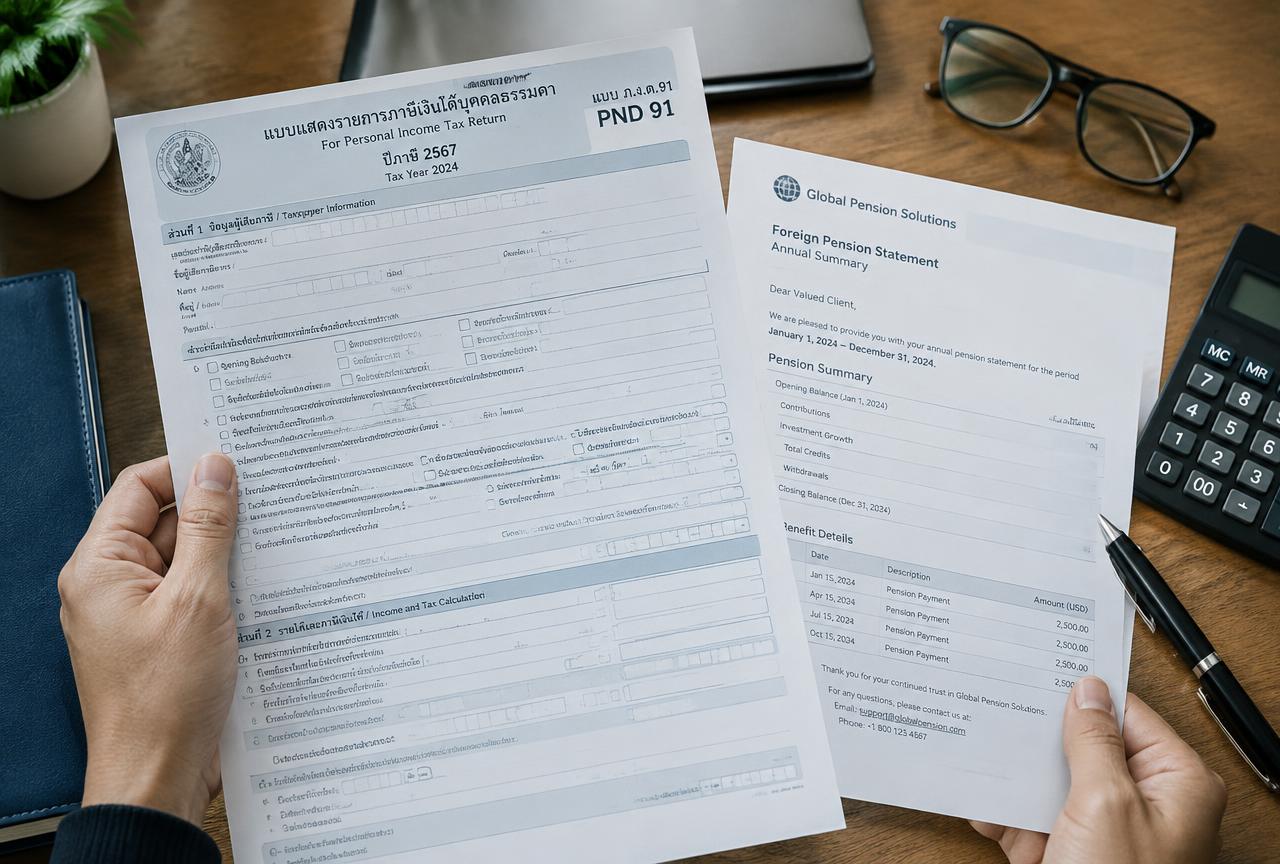
Practical steps for a newly arrived retiree
1. Determine your tax residence status
Count your days in Thailand for the tax year. If you reach 180, plan on the basis that you are a Thai tax resident.
2. Read the relevant double taxation agreement
Look at the pension article of the DTA between Thailand and the country paying your pension to see which state has taxing rights.
3. Prepare your pension documents
Request a pension statement from the payer, have it translated and certified through the proper chain, and keep evidence of every remittance.
4. Obtain a Thai tax identification number
Anyone with a filing obligation in Thailand needs a taxpayer identification number from the Revenue Department.
5. File the annual tax return
Tax residents with income above the threshold file form PND 90 or PND 91 by March of the following year.
6. Keep records for inspection
The Revenue Department may request supporting evidence retrospectively. Keep certificates, translations, and transfer records for at least five years.
What we handle, and what belongs to licensed specialists
We translate and certify all types of pension documents, notarise proof of life certificates through our Notary Public, and coordinate further legalisation at the Ministry of Foreign Affairs or embassies. We also prepare the income evidence package used for immigration extensions.
Tax calculation, treaty interpretation, and return filing are the work of licensed accountants and tax advisers. We work alongside those specialists and can introduce suitable firms, but we do not give tax advice directly, because the correct answer depends on each individual's circumstances.
A typical engagement with us starts before the tax year ends. Clients send us their pension statements and embassy letters, we confirm which documents need translation, notarisation, or legalisation, and we deliver a certified set that their accountant can file directly. Starting this in the final quarter of the year leaves comfortable room for the certification chain, which can involve offices in two countries.
Frequently asked questions
Is every foreign pension taxable in Thailand?
Not in every case. It depends on your tax residence status, the year the income arose, whether the funds are remitted into Thailand, and the double taxation agreement between Thailand and the paying country. Some treaties make government pensions taxable only in the paying state.
If I stay 179 days and then leave, am I no longer a tax resident?
The count uses the total days physically present in Thailand during the tax year. If the total is below 180, you are not a tax resident for that year. Planning around this should be discussed with a tax adviser, because it has knock-on effects on visas and other rights.
Where do I get a proof of life certificate signed?
It depends on the pension fund's requirements. Many accept notarised signature verification by a Notary Public in Thailand; some require their own country's embassy. Read the form the fund sends you carefully before booking an appointment.
Do I have to file in Thailand even if tax was already withheld abroad?
You may still need to file, but tax already paid abroad can usually be credited under the relevant double taxation agreement, so you do not pay the full amount twice. The details depend on the specific treaty.
Can I submit a German or French pension document directly in Thailand?
Generally it must be translated into Thai or English by a certified translator, and some authorities require the translation to be further legalised at the Thai Ministry of Foreign Affairs.
What happens if I never file a Thai tax return?
Anyone with a filing obligation who does not file can be assessed retrospectively with surcharges and penalties. Remittances through the banking system leave traceable records. Consulting a specialist early reduces this risk.
Official sources
Related services
Send us your pension documents for review
Send your pension statement or the form from your pension fund, and our team will confirm what needs translating, notarising, or legalising — with realistic steps and timelines.
Contact the team