
What is Russian Notarized Translation
Notarialny Perevod is a notarized translation certified by Apostille or the Russian Embassy. Required by ZAGS (civil registry), FMS (immigration), Rosobrnadzor (qualification recognition), and Russian courts.
Russian translations certified by the Russian Embassy in Bangkok — for Russia, Belarus, Kazakhstan, Uzbekistan, and all CIS countries.
Thai Notary Law & Service Co., Ltd. — Tax/Reg ID 0405565001923. Company registration and attorney certificates are displayed below.
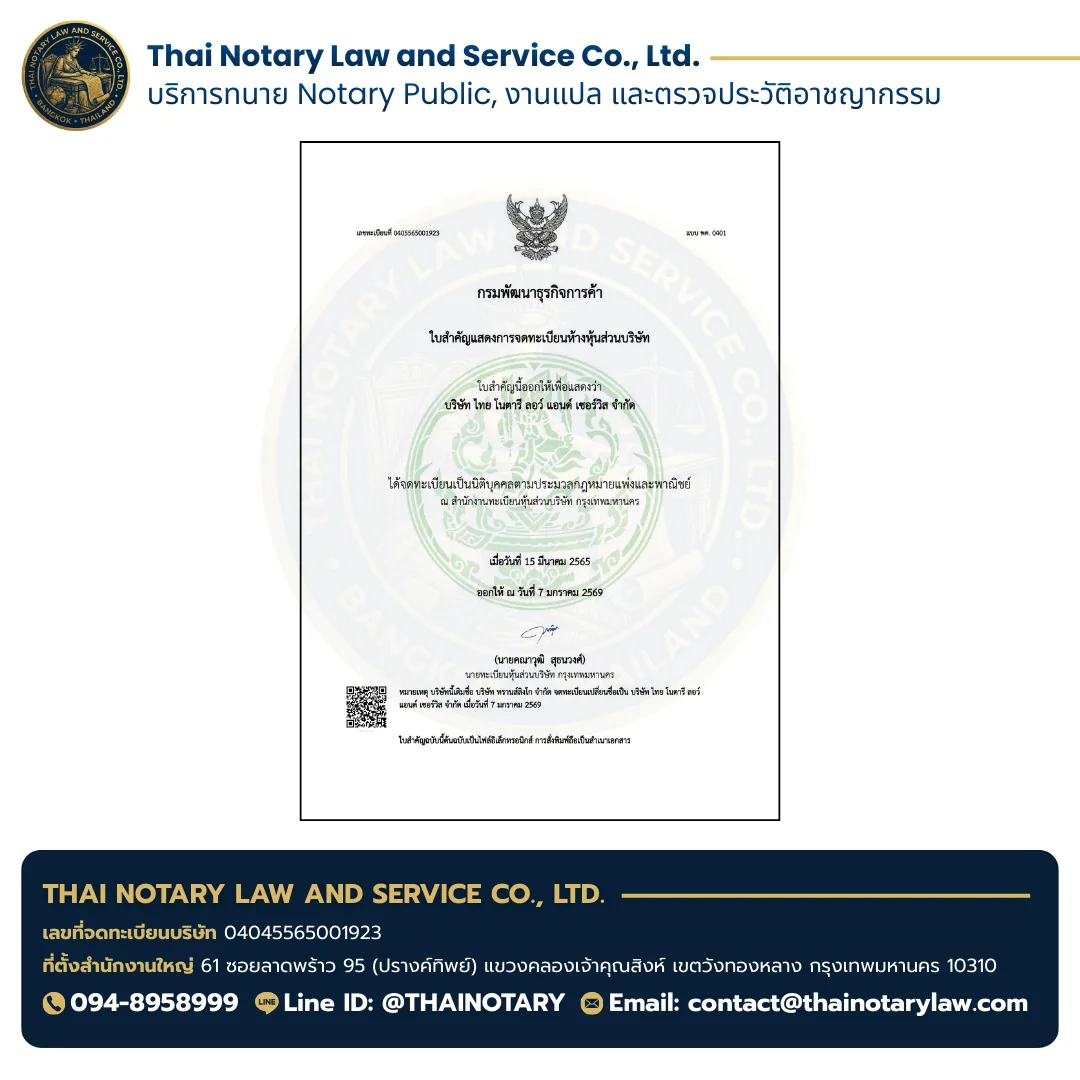
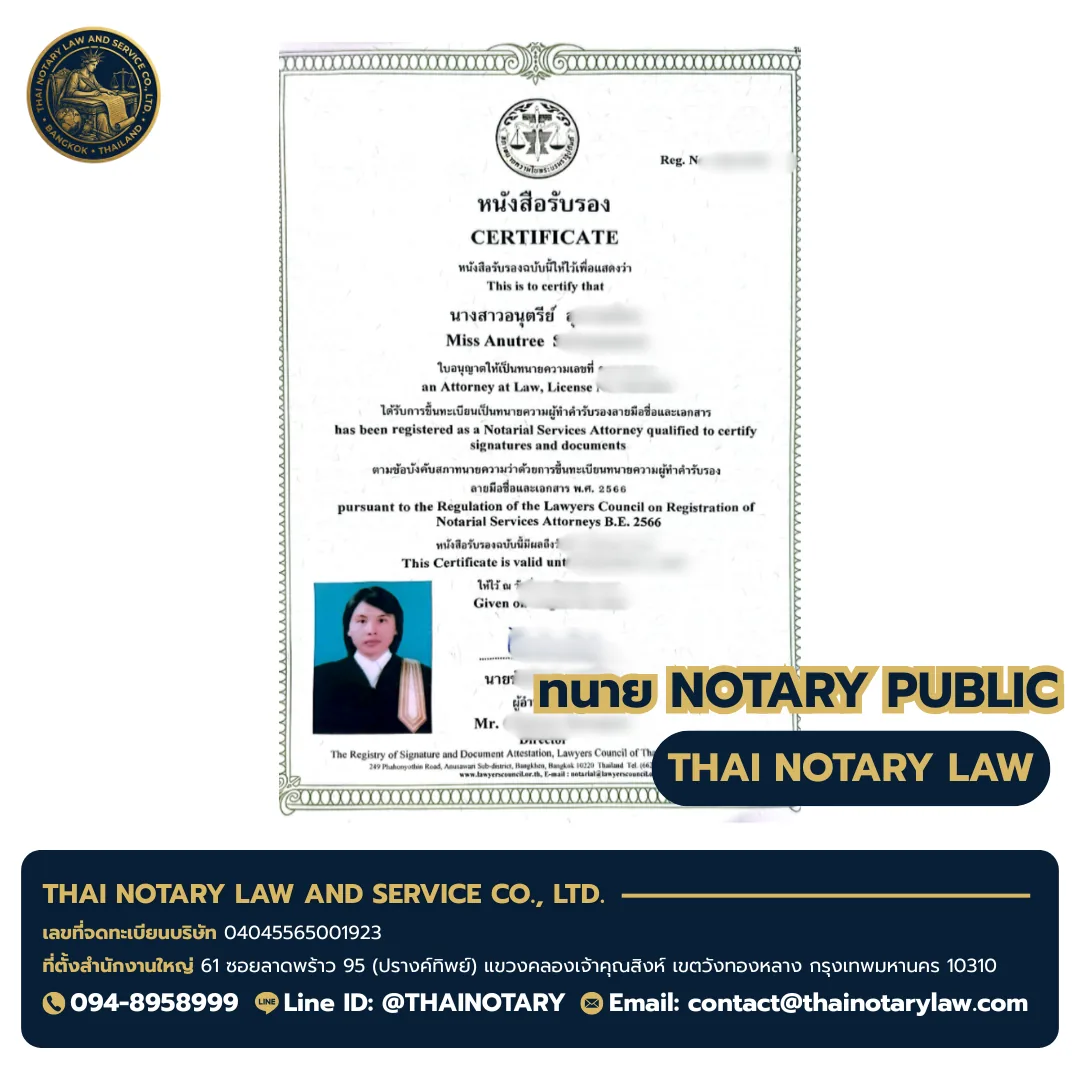
Russian notarized translation by native translators, quotation from staff, full Notary + MFA + Russian Embassy certification; Apostille from 28 Feb 2027.
Notarialny Perevod is a notarized translation certified by Apostille or the Russian Embassy. Required by ZAGS (civil registry), FMS (immigration), Rosobrnadzor (qualification recognition), and Russian courts.
Russian translations for: birth/marriage certs (ZAGS), single status, degree/transcript (Rosobrnadzor), passports, Migration Cards, criminal records. For Russian PR, ZAGS marriage in Moscow, MGIMO/MSU university admission.
Russia is a Hague Apostille member, but Thailand will issue Apostilles from 28 February 2027 — until then Thai documents require MFA legalisation followed by the destination embassy. Belarus, Kazakhstan and Uzbekistan are also members, though some agencies still require embassy certification.
Hi-res scans accepted.
Staff issue a written quotation after reviewing the documents.
Native + translator-certified.
Second translator proofreads.
Verify Cyrillic transliteration.
Notary stamp and signature.
Timing follows the Department of Consular Affairs queue and notices.
After MFA (Apostille replaces this from 28 Feb 2027).
For specific CIS agencies.
EMS / DHL / Russian Post.
PDF copy for your records.
We review the reason with you if the receiving authority requests changes.
Marriage at ZAGS in Moscow/St. Petersburg requires Thai single status (CCM) + Russian translation + Apostille. Two Russian-speaking witnesses required. ZAGS waiting period 30-90 days.
Russian PR requires: marriage cert, birth cert, criminal record, health cert (HIV, TB, drug). All Russian-translated with MFA legalisation and embassy certification (Apostille from 28 Feb 2027). Citizenship adds Russian B1 language test and 5-year residency.
Students at Russian universities (MGIMO, MSU, RUDN, Bauman) need Rosobrnadzor recognition. Russian-translated degree + transcript with MFA legalisation and embassy certification (Apostille from 28 Feb 2027). Medical students add Russian Medical License exam.
Russian names are written in Cyrillic and include a patronymic (отчество) that Thai documents do not have. Translations should keep all three parts and use the Roman spelling from the person’s international passport rather than a fresh transliteration.
Russia, Kazakhstan and Ukraine are parties to the Apostille Convention, but for Thailand the system only takes effect on 28 February 2027; until then documents for use in Thailand still need Thai embassy or consular legalisation plus the Department of Consular Affairs.
Russians living long-term in Phuket, Pattaya or Koh Samui often need driving licences, marriage and children’s birth certificates and income letters translated for the Land Transport office, immigration or schools. A Russian licence used to obtain a Thai licence is usually translated together with the embassy letter the transport office requires.
Re-issued Russian civil-status certificates (повторное свидетельство) carry an issue date different from the registration date. The translation should keep the two clearly apart, as Thai officers often mistake one for the date of birth or marriage.
Russian names have three parts: surname, given name and patronymic (отчество) — Ivanovna means “daughter of Ivan”. Thai forms have no patronymic field, so we keep it within the full name as on the passport rather than dropping it, so that it matches other Russian records.
Cyrillic can be romanised under several standards — the same name may be Yulia, Iuliia or Julia. We follow the person’s international passport.
Russia, Kazakhstan, Belarus and Ukraine are Apostille members, so their documents often arrive already apostilled. A Thai translation is still needed, and the apostille page must be translated too.
Notarial Services Attorneys in Thailand must hold a licence from the Lawyers Council of Thailand under the 2003 Notarial Services Regulation.
Read full text →Thailand’s Apostille accession (30 June 2026) only enters into force on 28 February 2027 — documents require dual legalisation by MFA Consular Affairs and the destination embassy.
Read full text →Russia records foreign names in Cyrillic; new documents must reuse the exact transliteration from prior visas or permits, otherwise registries cannot match the person.
Degrees and transcripts used for study or work in Russia require Rosobrnadzor recognition; translation and embassy legalisation alone are not sufficient.
Russian residence permits require a fixed test list — HIV, tuberculosis and drugs; a certificate missing any item must be redone and retranslated.
Russian documents include a patronymic field; the translation must state clearly how this is handled for Thai nationals who have none, to avoid registry queries.
Send your document details for staff to assess the steps and timing before work begins.
Mon-Fri 09:00-18:00 • Sat–Sun 09:00–17:00 (ICT)