
Apostille Thailand 2026
Thailand acceded to the Apostille Convention on 30 June 2026, and it enters into force for Thailand on 28 February 2027 — after that, Thai documents will be accepted in fellow contracting states without embassy legalisation.
Convention enters into force in
137 days 1h
Why Apostille Changes Everything
Authenticates signatures, seals and signatory capacity
Used between states where the Convention applies
Does not certify the document’s contents
Recipient requirements must still be checked
Comparison: Before vs After Apostille
Before Apostille (Current)
- 1Notary Public certification
- 2MOJ translation
- 3Thai consular legalization
- 4Destination embassy legalization
Once in force for Thailand (28 Feb 2027)
- 1Notary Public certification
- 2Apostille (single step)
Apostille Thailand Timeline
9 Dec 2025
Cabinet approved accession
30 Jun 2026
Thailand deposited its instrument of accession
Before 28 Feb 2027
MFA and destination-mission legalisation still apply
28 Feb 2027
Convention enters into force for Thailand
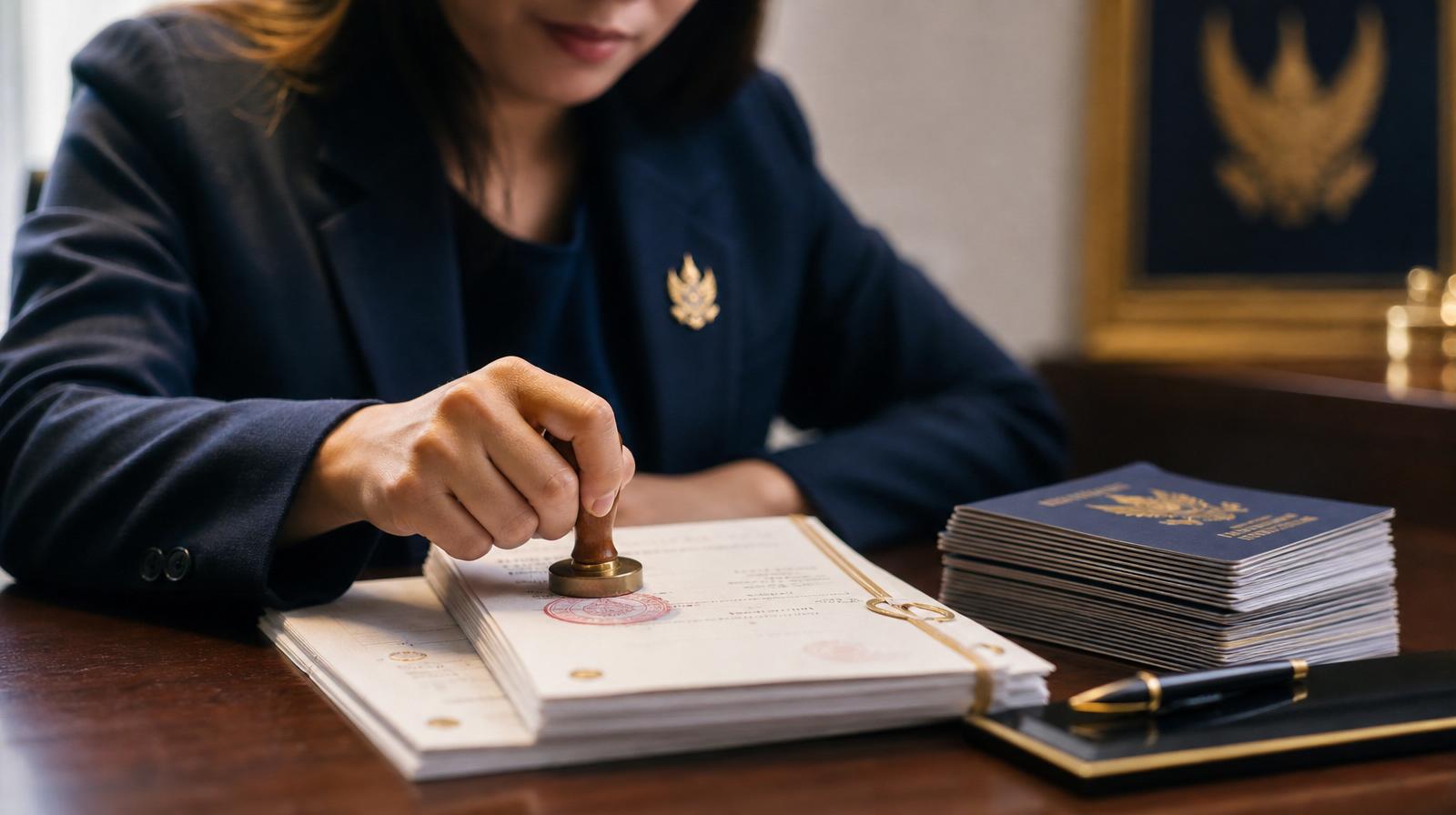

What the Apostille Convention is, and what changes for Thai documents
The Hague Convention of 1961 Abolishing the Requirement of Legalisation for Foreign Public Documents lets a public document issued in one contracting state be used in another with a single standard certificate — the apostille — instead of legalisation by the destination country’s embassy or consulate. An apostille confirms the authenticity of the signature, seal and capacity of the person who signed the document; it does not confirm that the document’s content is correct.
Today a Thai document for use abroad passes through two stages: legalisation by the Department of Consular Affairs at the Ministry of Foreign Affairs, then legalisation by the destination country’s embassy or consulate in Thailand. Once the Convention is in force for Thailand, a document bound for a fellow contracting state will need only an apostille from the authority Thailand designates — fewer steps and a shorter overall timeline per file.
The verified timeline
Thailand deposited its instrument of accession with the Netherlands Ministry of Foreign Affairs, the depositary, on 30 June 2026. Following the eight-month objection period, the Convention enters into force for Thailand on 28 February 2027. Both dates are confirmed by HCCH and Thailand’s Ministry of Foreign Affairs.
Until 27 February 2027 every Thai document for use abroad still follows the traditional legalisation route in full. If your submission date falls near the changeover, plan for the rule that will apply on the day the document is actually used, not the day it is signed.
Which documents are in scope, and which are not
The Convention covers public documents: documents from a court authority or official, administrative documents such as marriage registers, birth certificates and company certificates, documents attested by a Notarial Services Attorney, and official certificates placed on private documents such as signature registrations. It does not cover documents executed by consular officers, or administrative documents dealing directly with commercial or customs operations.
Privately prepared documents such as powers of attorney and sworn statements enter the apostille system only after their signature has been attested by a Notarial Services Attorney. Preparing the document correctly therefore matters as much as before, even though the final certification step becomes shorter.
Non-contracting states keep the traditional route
An apostille works only between contracting states. If the destination country is not a party, Thai documents still need Department of Consular Affairs legalisation followed by that country’s embassy. In addition, an existing contracting state may object to Thailand’s accession, in which case the Convention does not apply between Thailand and that state. Check the country-by-country status in the HCCH treaty table before settling on a route.
Our team checks the destination country’s status for every file before work starts, and will tell you plainly which route your document should take on the day it will actually be used.
What to prepare now
If you know you will need Thai documents abroad after February 2027, you can prepare today: confirm the originals are correct and the names match the passport exactly, ask the receiving authority whether it will accept an apostille or requires another form, and arrange any certified translation the destination requires. With those three parts ready, your file can enter the final step as soon as the apostille system opens.
Frequently Asked Questions
What is Apostille?+
An Apostille is a certificate under the 1961 Hague Convention. It authenticates the signature, seal and capacity of the signer of a public document. Use depends on whether the Convention applies between the origin and destination states.
When will Thailand start Apostille?+
Until 28 February 2027 Thailand does not issue Apostilles. Thai public documents are legalised by the Department of Consular Affairs, Ministry of Foreign Affairs, and then by the destination country mission where that country requires it.
Which documents can use Apostille?+
Birth/death/marriage certificates, academic transcripts, power of attorney, affidavits, corporate documents, contracts, and other public documents.
How is it different from current consular legalization?+
Before 28 February 2027, Thai documents still require MFA legalisation and destination-mission legalisation where required. After entry into force, confirm that the destination is a contracting state and that the Convention applies between both states.
Can I pre-book Apostille service?+
Contact Line @ThaiNotary and our team will review your documents and advise whether to use current legalisation or wait for the Apostille system.
Ready on Day One
Pre-book today for an initial case assessment with our expert attorneys, so your documents are ready from the day the Convention takes effect.
Reserve via Line


