Thai Apostille in force 28 Feb 2027 · Timeline & how to prepare →
Skip to content
Thai Notarial Services Attorney notarizing a signed document
Licensed by Lawyers Council

Notary Public Document Certification

Review the document type, signatory identity, translation and receiving-authority rules before selecting the appropriate notarial, legalisation or embassy route.

Notary Public Document Certification by Thai Notary Law & Service Co., Ltd. — Registered Notary Public Attorneys
Licensed & Trusted

Six Notarial Services Attorneys Licensed by the Lawyers Council of Thailand

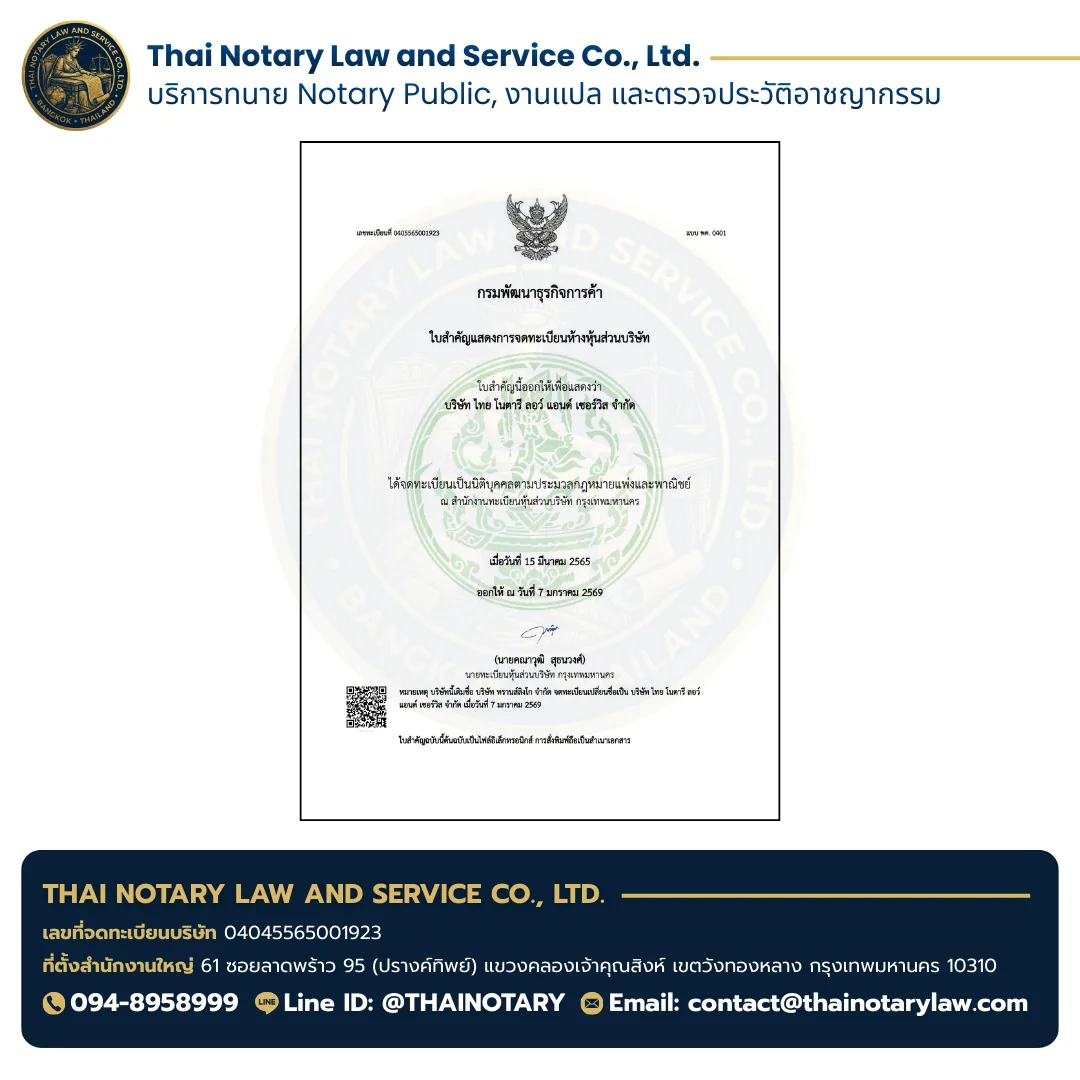
Thai Notary Law & Service Co., Ltd. — Tax/Reg ID 0405565001923. Company registration and attorney certificates are displayed below.

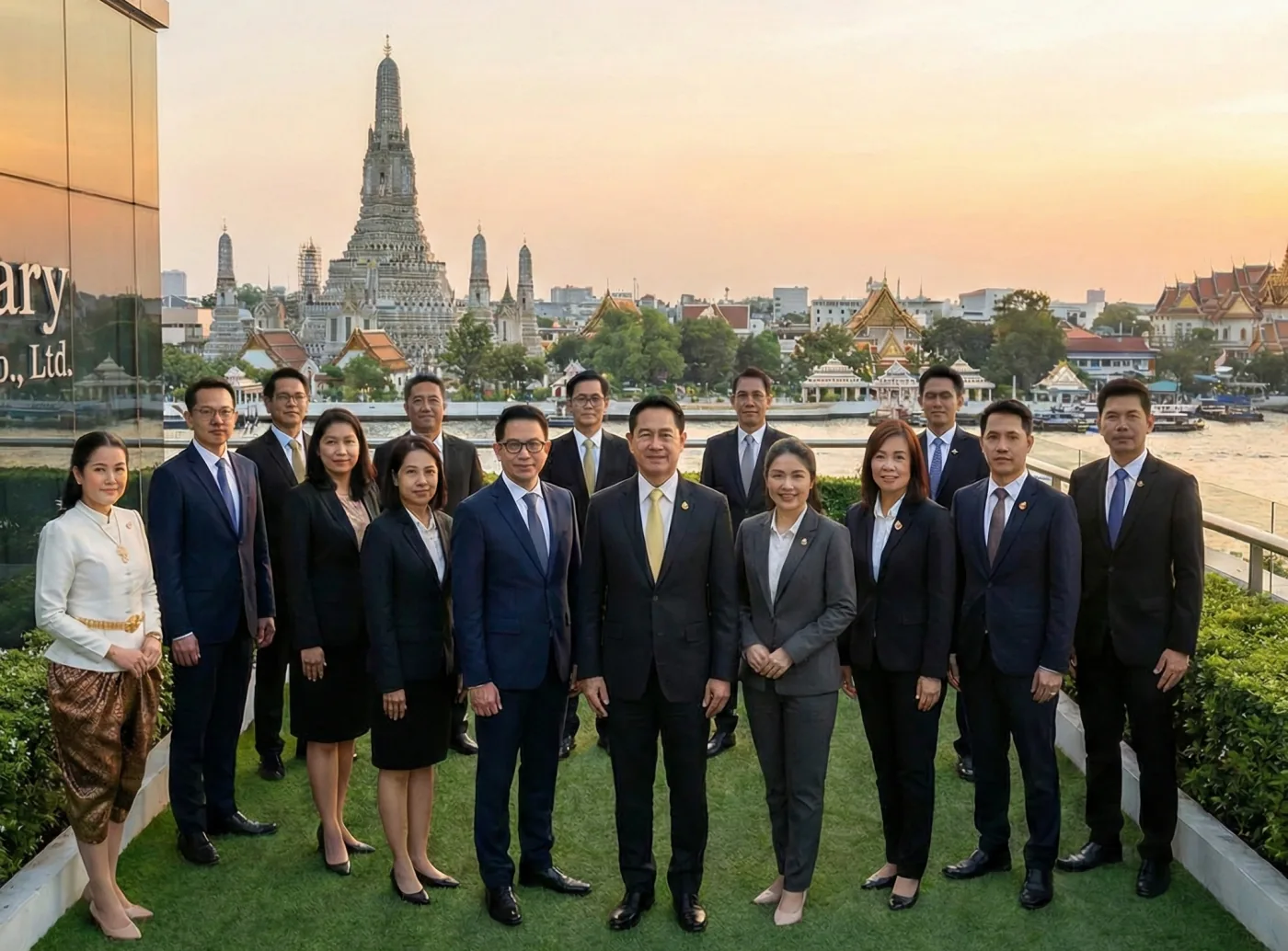
Thai Notary Law & Service team photograph in Bangkok
Our notary and legal team — head office in Wang Thonglang, Bangkok
Business Registration Certificate of Thai Notary Law & Service Co., Ltd. — Registration No. 0405565001923
Company Reg. No. 0405565001923

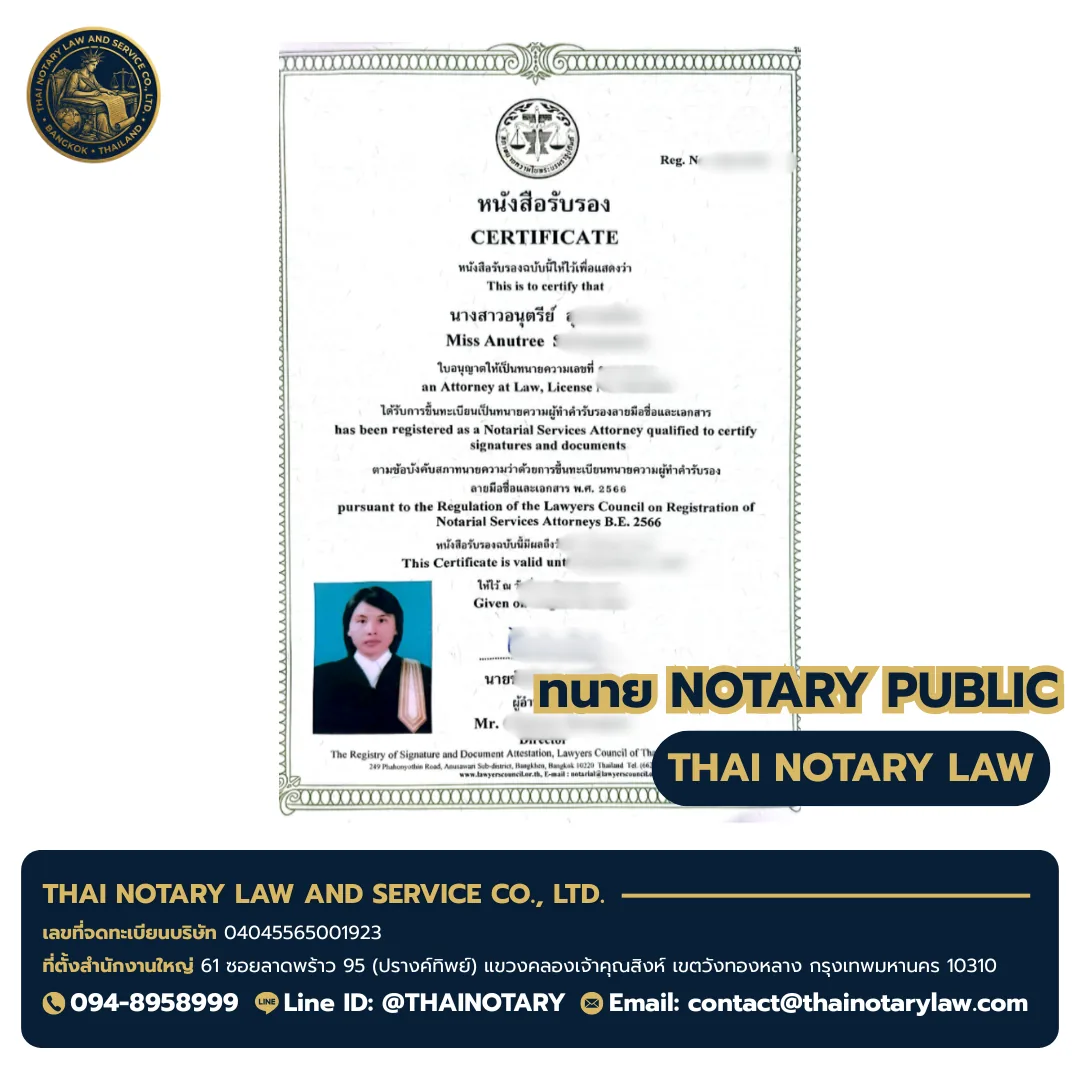
Notary License (1/6)

Notary License Miss Anutaree — Thai Notary Law & Service Co., Ltd.
Miss AnutareeCertified by The Lawyers Council of Thailand

Thai Notary Public Standards vs International

Thailand uses a Notarial Services Attorney framework administered by the Lawyers Council. Attorney certification does not make a document automatically acceptable abroad; the receiving authority’s rules on translation, legalisation or embassy authentication must still be checked.

The status and powers attached to “Notary” differ between jurisdictions. Before using a document, ask the receiving authority what fact must be certified, who must sign in person, and which additional authority steps are required.

Examples that require route checks before certification

1. Exporters

Export documents such as powers of attorney or company records may follow different routes by country, bank or counterparty. Obtain the recipient’s checklist before choosing notarial, MFA or embassy steps.

2. Overseas Students

Universities and professional bodies may request certified copies, translations or direct institutional delivery. Separate applicant-held documents from records that the institution itself must send.

3. Foreign Spouses

Cross-border marriage documents depend on nationality, the relevant embassy and the registering district office. Check marital-status evidence, translation and MFA requirements with both authorities.

4. Foreign Investors

Foreign corporate records may need proof of signing authority, company status and an authentication chain from the country of origin. Confirm the format accepted by DBD, BOI or the counterparty for the specific transaction.

Legal Framework Cited by Thai Notary Law

The professional framework for Notarial Services Attorneys is administered by the Lawyers Council. Using a Thai document abroad is a separate question involving MFA legalisation rules, embassy requirements and the receiving authority’s instructions. Statutory provisions should not be quoted or summarised without checking the official text and the facts of the matter.

The certifier’s name and current professional status should be checked with the relevant professional body when the service is used. Copy retention, disclosure and original-document handling should be defined in the engagement scope and privacy terms for each matter.

Five Levels of Document Certification

  1. Self-Certification: Domestic use only; some agencies accept it; no international legal effect.
  2. Lawyer Certification: Acceptance depends on purpose, signatory and recipient, so the required scope must be checked first.
  3. Notary Public Certification: Used where the receiving authority accepts this form of notarial act; its current requirements must be checked first.
  4. Consular Legalization: Thailand’s Department of Consular Affairs legalises eligible documents and signatures under its current rules; check its latest document list and format requirements.
  5. Apostille / Embassy Legalization: Thailand acceded on 30 June 2026 and the Convention enters into force for Thailand on 28 February 2027. Until then, Thai documents continue through MFA and embassy legalisation as required by the destination.

Quick Answer — What is Notary Public?

A Notarial Services Attorney verifies identity, signing or copies within the defined scope. Actual use still depends on the receiving authority, so translation, legalisation and embassy requirements must be checked separately.

Why Choose a Licensed Notary Public

01

Check the destination first

The correct certification depends on purpose and recipient rules. A notarial step alone should not be assumed sufficient for every authority.

02

Verify the certifier

Before signing, verify the lawyer, certification scope and identity evidence required so the certificate matches the facts on that date.

03

Build the route from recipient rules

Start with recipient instructions, then sequence only the translation, notarial, MFA or embassy steps that the document actually needs.

Notary Public work we assess

Signature Certification

Professional signature certification service by licensed Notary Public attorneys from the Lawyers Council of Thailand. For domestic and international use. request a quotation.

Certified True Copy

Certified true copy service ensuring documents match originals, by licensed Notary Public. For government agencies, embassies, and international use. request a quotation.

Translation & Certification

Thai-English document translation with Notary Public certification. Accepted by embassies, government agencies, and courts worldwide. request a quotation.

Document Notarization

Full document notarization service by licensed Notary Public attorneys. For domestic and international use. request a quotation.

Consular Legalization

Complete consular and embassy document legalization service. From notarization to consular certification. request a quotation.

Consent Letter

Drafting and certification of all types of consent letters by Notary Public. Valid domestically and internationally. request a quotation.

Affidavit Certification

Drafting and certification of all types of Affidavits by Notary Public. For courts and agencies domestically and internationally. request a quotation.

Power of Attorney (POA)

Drafting and certification of all Power of Attorney types — General and Special POA by Notary Public. request a quotation.

Criminal Background Check

Criminal record check (CID), police clearance certification with Notary, Apostille, and consular. request a quotation.

Apostille

Thailand acceded to the Apostille Convention on 30 June 2026. It enters into force for Thailand on 28 February 2027; until then, current legalisation procedures apply.

NAATI Certification

Document translation by NAATI certified translators for Australian visas, immigration, and government agencies. request a quotation.

Oath & Affirmation

Professional oath and affirmation services by licensed Notary Public attorneys. For court documents, government agencies, and international organizations. request a quotation.

Witnessing Services

Professional witnessing services by Notary Public attorneys for contracts, sales, and all important documents. request a quotation.

Corporate Document Certification

Corporate document certification — company certificates, MOA, AOA, financial statements, board resolutions by Notary Public. request a quotation.

Real Estate Document Certification

Certification of land sales, condo transfers, lease agreements, mortgages by Notary Public. request a quotation.

Marriage & Divorce Document Certification

Marriage registration, divorce, prenuptial agreement certification by Notary Public. request a quotation.

Will & Testament Certification

Will & testament drafting and certification by Notary Public under CCC Section 1646. request a quotation.

Educational Document Certification

Certification of diplomas, transcripts for studying or working abroad. request a quotation.

Visa & Immigration Document Certification

Certify visa applications, work permits, and immigration documents by Notary Public. request a quotation.

DBD Director Signature Certification

Director signature certification by Notary Public for filings with the Department of Business Development (DBD), Ministry of Commerce. request a quotation.

Person & Life-Status Verification

Identity, photo, and Life Certificate verification for foreign pension claims and international transactions. request a quotation.

Certification of Existence of Documents

Certifies that a document or legal act exists at the time of notarization, for legal use in Thailand and abroad. request a quotation.

Embassy Legalization (Translation + Stamping)

Translation and full embassy legalization at the destination country embassy in Thailand. End-to-end Notary + MFA + Embassy. request a quotation.

Legal & Contract Translation

Legal & contract translation — sales contracts, leases, wills, judgments, POAs — by specialist legal translators with notary certification. request a quotation.

How to Use Notary Public Service

1

Contact via Line @ThaiNotary or call 094-895-8999

2

Specify document type and purpose

3

Send copies for review via Line/Email

4

Receive quotation and timeline

5

Review the quotation and confirm the scope

6

Prepare originals as advised

7

Bring documents to office or meeting point

8

Attorney reviews, certifies, and stamps

9

Receive certified documents

10

Consular/embassy follow-up if needed

11

Document delivery (domestic/international)

Frequently Asked Questions About Notary Public

Most-searched questions about Notary Public and document certification

Direct answers to the questions people most often search before choosing a provider. Each answer states the rule first, then what it means in practice.

Who is a Notary Public in Thailand and what can they certify?

Thailand does not operate a separate notary profession as some countries do. It uses Notarial Services Attorneys — lawyers who have completed the training and are registered with the Lawyers Council of Thailand. Typical acts are certifying a signature executed in the attorney’s presence, certifying that a copy matches the original examined, administering an oath or affirmation, and certifying facts personally witnessed, all within the scope the law and the Council’s regulations allow.

How do I know whether my document needs notarisation?

The receiving authority decides, not the sender. Read the instruction letter, application form or website of the university, embassy, bank, registrar or counterparty and note the exact wording: notarised, certified true copy, sworn statement or legalised. Then work backwards to sequence the steps, because each of those terms refers to a different act. Starting from the actual written requirement avoids duplicated work and rejected documents.

What is the difference between certifying a copy and certifying a signature?

Certifying a copy confirms that the attached copy matches the original the attorney examined, so the original must be produced. Certifying a signature confirms that the named person signed in the attorney’s presence after producing identification, so the signatory must attend and must not have signed in advance. Neither act certifies that the content of the document is true or legally valid — that distinction matters when an authority asks for one and not the other.

What should I bring on the day of notarisation?

Bring the original document to be certified, valid photo identification such as an ID card or passport, and — if signing for a company — the current company affidavit plus evidence of signing authority. Bring the receiving authority’s instruction letter if you have one, because some bodies prescribe specific wording for the certificate. If a translation is needed, say which target language in advance so the steps can be sequenced correctly.

When will Apostille apply to Thai documents?

Thailand acceded to the Apostille Convention on 30 June 2026, and the Convention enters into force for Thailand on 28 February 2027. Until that date, Thai documents for overseas use still follow the existing route: legalisation by the Department of Consular Affairs of the Ministry of Foreign Affairs, followed by the destination country’s embassy or consulate where required. Once it is in force, confirm with the receiving authority whether it accepts an Apostille or still asks for the previous chain.

Should a document be translated first or certified first?

The order depends on the receiving authority. Some require the Thai original to be certified first and the translation certified afterwards; some require the translation attached to the original and certified together as one bundle; some accept translations only from specified translators. Getting the order wrong usually means repeating the whole chain, so confirm both the sequence and the required binding format with the receiving authority before the first step.

Who signs when a company document is notarised?

The signatory must be a director with signing authority as shown on the current company affidavit, or an attorney-in-fact holding a power of attorney with a clearly defined scope, with identification for both grantor and grantee. If the affidavit requires joint signatures and a company seal, all of those conditions must be met. Otherwise the receiving authority may reject the document even though the signature certification itself was performed correctly.

Can a document be notarised without attending in person?

It depends on the act. Preliminary document review and drafting the certificate wording can be done from copies sent in advance. Signature certification, by its nature, requires signing in the attorney’s presence with identification produced, and copy certification requires the original to be examined. Plan which steps can be handled remotely and which need attendance, then arrange a single appointment that covers all the in-person steps at once.

Why do notarised documents still get rejected?

Common causes: the wrong type of certification for what the authority specified, certificate wording that does not match a prescribed form, names or document numbers that differ from the passport or civil registry, a missing onward legalisation step, a translation that omits pages or seals, a document older than the recipient’s validity window, or a bundle separated after certification. Checking the written requirement before starting removes most of these failures.

Does a notarial certificate expire?

The certificate itself carries no built-in expiry, but many receiving authorities accept only documents issued within a set window, commonly three or six months. Certain source documents — a company affidavit or a civil registry extract, for example — carry their own freshness requirement. Check the recipient’s rule first, then schedule the certification dates so the bundle is still within the window on the day you actually file.

Ready for Notary Public Service?

Send document copies, purpose and receiving-authority details for a scope and process assessment.

Frequently Asked Questions — Notary Public

How does a Notarial Services Attorney differ from another Thai lawyer?
In Thailand, notarial acts are performed by lawyers trained and registered under the Lawyers Council framework. The scope and acceptance of each certification must be checked against the actual document and receiving authority; one certificate is not automatically valid worldwide.
What documents should I prepare for certification?
Bring the original document plus an ID card or passport. Companies should add their registration record. Send scans to staff for scope review and a quotation.
Can the whole process be done online?
Translation and copy certification can be done remotely — send scans via Line, we ship certified originals back. However, signature certification requires in-person signing, though off-site appointments are available.
Is a Notarial Certificate accepted everywhere abroad?
Acceptance is not universal. The receiving authority determines whether it requires a notarial act, Thai MFA legalisation, embassy legalisation or an Apostille, so its current instructions should be checked first.
What determines the processing time?
Timing depends on the document, whether signing must be witnessed, translation, and any later authority steps. The sequence can be assessed after reviewing copies and the receiving authority’s requirements.
Which languages are supported?
Thai–English is assessed first. Other languages require case-by-case confirmation of the translator, translation format and receiving authority’s rules before engagement.
What should I do if a document is rejected?
Request the receiving authority’s written reason, then check whether the issue concerns format, signatory, translation or authentication sequence before agreeing the corrective scope and cost.
How is the service fee assessed?
The assessment considers document type and volume, signatories, language pair and required authority steps. Scope and costs are provided for review before work starts.
Can documents be delivered?
Delivery options depend on the destination and the original document. Confirm the recipient, address, tracking method and handling risks before dispatch.
What payment methods do you accept?
Bank transfer, PromptPay, credit card (via payment link). Official receipts and tax invoices issued every time.

Auto-suggested based on topic relevance and the next step in your journey.

ทิศทางขาเข้า: เอกสารที่ออกในต่างประเทศต้องผ่านการรับรองจากหน่วยงานของประเทศผู้ออก แล้วรับรองที่สถานเอกอัครราชทูตไทยในประเทศนั้น หรือรับรองโดยคณะผู้แทนของประเทศผู้ออกในไทย จากนั้นจึงแปลเป็นภาษาไทยและให้กรมการกงสุลรับรองคำแปล เนื่องจากอนุสัญญา Apostille จะมีผลกับไทยวันที่ 28 ก.พ. 2027 (ไทยเข้าเป็นภาคี 30 มิ.ย. 2026) จนถึงวันนั้น 1961 อาโพสทิลเพียงอย่างเดียวจึงไม่เพียงพอ

นอกจากงานแปล รับรองเอกสาร และนิติกรณ์ เรารับงานฝั่งองค์กรต่อเนื่องในสำนวนเดียวกัน ทั้งจดทะเบียนนิติบุคคล บัญชี–ภาษี–ประกันสังคม สัญญาและคดีความ วีซ่าและใบอนุญาตทำงาน งานทะเบียนครอบครัว และการวางระบบเอกสารดิจิทัล เลือกหัวข้อที่ตรงกับงานของคุณเพื่อดูรายการเอกสาร ขั้นตอน และข้อควรระวัง

About Thai Notary Law — Why Trust Us

Thai Notary Law & Service Co., Ltd.

  • 6 licensed Notary Public attorneys registered with the Lawyers Council of Thailand under the Lawyer Act B.E. 2528
  • Document intake from all 77 provinces, with a verifiable job reference on every certificate
  • Head Office: 61 Soi Ladprao 95 (Prangtip), Khlong Chaokhun Sing, Wang Thonglang, Bangkok 10310
  • Company Registration: 0405565001923

Branches & Service Areas

  • 🏢 Bangkok: 61 Soi Ladprao 95 (Prangtip), Khlong Chaokhun Sing, Wang Thonglang, Bangkok 10310
  • 🏢 46/1-2 Moo 2, Chimphli Rd., Nai Mueang, Mueang, Khon Kaen 40000
  • 🏢 31/43 Si Chom Chuen Rd., Mak Khaeng, Mueang, Udon Thani 41000
  • 🏢 161 Moo 1, Pa Kho, Mueang, Nong Khai 43000
  • ✅ Coverage: 50 Bangkok districts + 77 provinces nationwide
  • 🌐 Online service worldwide — available for overseas clients
Real Work From Our Team

Our Work Samples

Real work samples from Thai Notary Law —, attorneys registered with the Lawyers Council of Thailand, individual and corporate clients nationwide

1 / 25

Notary Public Near You — Near Me

Our physical offices are in Bangkok, Khon Kaen and Udon Thani. Other areas are served by appointment, partners and postal or courier document handling. Send a copy and the destination country so staff can confirm the route before an appointment.

Sample documents certified by our Notary Public

Real work from Thai Notary Law attorneys — legally compliant certifications accepted by embassies, consulates, and government agencies worldwide.

Statutory Declaration certified by attorney | Thai Notary Law

Statutory Declaration certified by attorney

Certified utility bill / proof of address | Thai Notary Law

Certified utility bill / proof of address

Certified business / corporate document | Thai Notary Law

Certified business / corporate document

Certified True Copy of National ID | Thai Notary Law

Certified True Copy of National ID

* Personal information in sample documents is blurred to protect client privacy.

แหล่งอ้างอิงและข้อเท็จจริง · Sources & facts

  • Notary Public ในประเทศไทยคือทนายความที่ขึ้นทะเบียนกับสภาทนายความที่มา: สภาทนายความ · ตรวจสอบล่าสุด 2026-10-09
  • ลำดับการรับรองเอกสารขึ้นอยู่กับประเทศปลายทางและหน่วยงานผู้รับที่มา: กรมการกงสุล กระทรวงการต่างประเทศ · ตรวจสอบล่าสุด 2026-10-09
  • ขอบเขตงานและใบเสนอราคาต้องตรวจจากเอกสาร ประเทศปลายทาง และขั้นตอนของหน่วยงานผู้รับที่มา: ติดต่อเจ้าหน้าที่ Thai Notary Law · ตรวจสอบล่าสุด 2026-10-09
ตรวจสอบล่าสุด 9 ตุลาคม 2569 โดย ทนายผู้ทำคำรับรองของสำนักงาน (สภาทนายความในพระบรมราชูปถัมภ์)
เขียนโดย · Written by
ทีมทนายความผู้ทำคำรับรองลายมือชื่อและเอกสาร Thai Notary Law
ทนายความผู้ทำคำรับรองลายมือชื่อและเอกสาร (Notarial Services Attorney) · สภาทนายความในพระบรมราชูปถัมภ์
ตรวจทานโดย · Reviewed by
ทนายผู้ทำคำรับรองของสำนักงาน
ตรวจทานเนื้อหาด้านขั้นตอนและข้อกฎหมาย · สภาทนายความในพระบรมราชูปถัมภ์
เผยแพร่ 15/1/2569 · ปรับปรุง 9/10/2569

Notary Public service matrix — 42 document types

4,602 specialised pages. Pick document × visa × destination — each page ≥ 2,000 unique words.

All document types

Featured destinations

By visa subclass

Notarial Services Attorney Analysis
E-E-A-T

Notary Public in Thailand: Legal Framework, Scope, and International Recognition

Thailand follows the Civil Law tradition and does not have a "notaire" in the French or German sense. Instead, the Lawyers Council of Thailand (under Royal Patronage) operates the "Notarial Services Attorney" program under the 2008 Council Regulation on the Registration of Attorneys Who Notarize Signatures and Documents. To certify, the attorney must be a Council member, complete the dedicated training, and hold a Notarial Services Attorney registration number verifiable with the Council. Notarial Services Attorneys are authorized to: (1) certify signatures (acknowledgement / jurat) — the signer must appear in person with valid ID; (2) certify true copies against originals; (3) certify translations as accurate; (4) administer oaths, statutory declarations and affidavits; (5) certify corporate documents for overseas use such as Power of Attorney, Board Resolutions and Certificates of Incumbency. For overseas use, Thailand acceded to the HCCH 1961 Apostille Convention on 30 June 2026, in force for Thailand on 28 February 2027. From that date notarized documents can obtain an Apostille from the Department of Consular Affairs, Ministry of Foreign Affairs, valid in 120+ member states without further embassy steps. For non-member countries (e.g. Canada, China, Iran), the legacy Consular Legalization route (MFA + destination embassy) still applies in sequence. E-E-A-T Notice: This page is authored by our in-house Notarial Services Attorneys and professionally reviewed by a senior attorney registered with the Lawyers Council of Thailand. Content is kept current with the latest Council and MFA notices.

Legal Basis

2008 Lawyers Council Regulation on the Registration of Notarial Services Attorneys.

International Recognition

Apostille takes effect for Thailand on 28 Feb 2027; until then, MFA and embassy legalisation.

Oversight

Lawyers Council enforces ethics and continuing competence; the Notary Register is fully auditable.

Frequently Asked Questions

Authored by our Notarial Services Attorneys · Professionally reviewed by a senior attorney (Lawyers Council of Thailand) · References: Lawyers Council & MFA Department of Consular Affairs official notices.

Thai Notary vs Global Notary Systems

A side-by-side view of scope, authority, and fees across the four notarial systems our clients ask about most.

FeatureThailand (Notarial Attorney)United States (Notary Public)United Kingdom (Notary)Australia (JP)
Issuing authorityLawyers Council of ThailandSecretary of State (per state)Court of Faculties (Archbishop of Canterbury)State Governor / Dept. of Justice
QualificationLicensed lawyer + specialized training + examNot required to be an attorneyMust be a Solicitor for many yearsAppointed senior citizen
ScopeSignatures, copies, oaths, translationsSignatures primarilyInternational-use documentsCopies and general signatures
International recognitionMFA + Embassy legalization (Thailand not yet Hague)Apostille under HagueApostille under HagueApostille under Hague

Scope, authority and rules differ by jurisdiction and receiving body; verify the primary source before use.

Notary Glossary

Key terms used across notary, apostille, and legalization workflows.

Notarization
Formal authentication of signatures, copies, or oaths by an authorized officer.
Apostille
Certification stamp for use in Hague Convention 1961 member states (Thailand’s Apostille accession (30 June 2026) only enters into force on 28 February 2027).
Legalization
Sequential authentication via the MFA and the destination embassy.
Attestation
A witness certification confirming the truth of a statement or signature.
Certified True Copy
A copy officially confirmed to match the original document.
Affidavit
A written statement sworn under oath before an authorized officer.
Power of Attorney (POA)
A legal instrument granting another person authority to act on your behalf.
Notarial Certificate
The certificate issued by a Notary carrying international legal weight.
MFA (Ministry of Foreign Affairs)
The second-tier authority certifying documents for international use.
Consular Legalization
Final certification by the destination country's embassy.
Sworn Translator
A translator registered with a state authority whose translations carry official status.
NAATI
National Accreditation Authority for Translators and Interpreters — the Australian standard.
E-Notarization
Electronic notarization (not yet officially recognized in Thailand).
Notarial Register
The book of notarial acts a Notary is legally required to maintain.
Jurat
The closing clause of an affidavit stating when, where, and before whom the oath was made.

Documents to prepare — verified against the authority’s own guidance

This list reflects the requirements published by the responsible authority on the verification date. Authorities may change their conditions, so confirm with the source before lodging.

What to prepare for a Thai Notarial Services Attorney

  • The original document to be notarised, together with a copy
  • Original passport or national ID card of the signatory
  • The signatory must sign in the physical presence of the notarial services attorney
  • Company affidavit and seal when signing on behalf of a juristic person(case-dependent)
  • A translation of the document when the receiving party requires English(case-dependent)

Thailand has no statutory Notary Public office; the equivalent role is performed by a Notarial Services Attorney registered with the Lawyers Council of Thailand.

Source: Lawyers Council of Thailand · verified on 2026-07-31

The procedure, as the authority publishes it

The steps below are drawn from the procedures the responsible authority publishes itself, with the source and verification date shown. Some steps depend on the case and may change with the authority’s own announcements.

How a Thai Notarial Services Attorney certifies a document

  1. 1Confirm whether the receiving party needs a signature certification, a certified true copy or a certification of facts — each uses different certification wording.
  2. 2Bring the original document together with the signer’s valid passport or ID card so the attorney can verify identity.
  3. 3Sign the document in the attorney’s presence; do not pre-sign when the destination requires signing before the notarial officer.
  4. 4If signing for a juristic person, present a current company affidavit and evidence of authority to act.Depends on the case
  5. 5The attorney signs, seals and records the notarial registration number on the certification.
  6. 6Where the destination requires further authentication, take the document on to the Department of Consular Affairs and/or the destination country’s embassy in that order.Depends on the case

Thailand’s Apostille accession (30 June 2026) only enters into force on 28 February 2027, so documents follow the consular–embassy legalization route instead of an apostille.

Lawyers Council of Thailand · Source · verified 2026-08-10

Why submissions get turned back — and how to pre-empt it

Each point restates a condition the responsible authority publishes, with its source and verification date — not statistics or guesswork.

Why a Thai notarial certification is sometimes refused abroad

The document was signed before meeting the attorney

A signature certification states that the signer signed in the attorney’s presence. If it was signed earlier, that fact cannot be certified and the document must be re-signed in person.

The destination asked for an apostille

Thailand’s Apostille accession (30 June 2026) only enters into force on 28 February 2027. Thai documents instead run through MFA legalization and then the destination embassy; tell the receiving party this at the outset.

Expired ID, or a name spelled differently from the document

Identity must be verified from an unexpired document, and the spelling in the certification must match the passport the destination will check against.

No current evidence of authority to sign for the company

Certifying a director’s signature relies on a current company affidavit showing signing authority; an outdated affidavit that no longer reflects the authority will be rejected.

Lawyers Council of Thailand · Source · verified 2026-08-10

Comparing service routes against what the recipient requires

Every cell restates a condition published by the responsible authority, with its source and verification date. No fees or unpublished timeframes are stated.

Comparing routes for authenticating a document for overseas use

Each receiving authority sets its own authentication route. This table compares the published conditions so the route can be matched to what the recipient actually requires.

Comparing routes for authenticating a document for overseas use
CriterionMFA legalization (Department of Consular Affairs)Notarial Services Attorney certificationDestination embassy certification after legalization
Who certifiesDepartment of Consular Affairs, MFAAn attorney registered with the Lawyers Council of Thailand as a notarial services attorneyThe embassy or consulate of the destination country
Applies to which documentsThai official documents and translations matching the originalPrivate documents such as powers of attorney, affidavits and copies of personal recordsDocuments already legalized by the Department of Consular Affairs
Typically required byEmbassies and foreign bodies that require legalization firstUniversities, banks and overseas counterpartiesCountries that still apply their own additional certification step
Prerequisite before filingOriginal or issuer-certified copy plus a translation in the format the department specifiesThe signatory must appear in person with valid photo identificationPrior MFA legalization, plus that embassy’s own published conditions

Source: Department of Consular Affairs, Ministry of Foreign Affairs · verified 2026-08-10

Notarial Services Attorney certification vs MFA legalization

These two routes are not interchangeable. The receiving party decides which one applies, and in many files both are used in sequence.

Notarial Services Attorney certification vs MFA legalization
CriterionNotarial Services AttorneyMFA legalization
Who certifiesA lawyer registered with the Lawyers CouncilDepartment of Consular Affairs, MFA
What is certifiedThe signatory’s signature, the oath taken, and that a copy matches its originalThe seal and signature of the official or certifier appearing on the document
Document typesPrivate documents, affidavits, powers of attorney, company papers, passport copiesThai official documents and translations in the department’s required format
PrerequisiteThe signatory signs in the attorney’s presence with unexpired photo identificationAn original or issuer-certified copy plus a translation matching it exactly

Source: Lawyers Council of Thailand (Lawyers Act B.E. 2528 s.27 and the regulation on notarial services attorneys) / Department of Consular Affairs, Ministry of Foreign Affairs · verified 2026-08-16

Why Thailand does not issue an Apostille, and what replaces it

Overseas recipients often ask for an "Apostille" by default. This table maps that request onto what Thailand actually issues.

Why Thailand does not issue an Apostille, and what replaces it
CriterionApostille requestLegalization + embassy route
Thailand’s statusThailand’s Apostille accession (30 June 2026) only enters into force on 28 February 2027The standard route in use in Thailand
What is actually issuedNo Apostille certificate is issued in ThailandThe MFA legalization stamp followed by the destination embassy’s certification
Step afterwardsThe file moves to legalization plus certification by the destination embassyFile with the receiving country’s embassy or consulate under its own conditions
What to ask the recipientAsk in writing whether legalization is accepted in place of an ApostilleConfirm which translation language and format that embassy requires

Source: Department of Consular Affairs, Ministry of Foreign Affairs · verified 2026-08-16

Affidavit vs Statutory Declaration

Both record a declarant’s statement of fact, but recipients usually specify one form.

Affidavit vs Statutory Declaration
CriterionAffidavit (sworn statement)Statutory Declaration
Nature of the statementThe declarant swears or affirms before the attorneyThe declarant confirms a statement on the recipient’s prescribed form
Typically required byCourts, foreign government bodies and some financial institutionsBodies in Commonwealth jurisdictions such as Australia and the UK
What the attorney certifiesThe declarant’s identity, the oath, and the signature made in personThe declarant’s identity and the signature made before the attorney
Watch out forNever pre-sign; the content must be facts within the declarant’s own knowledgeUse the recipient’s own form version and leave no blank fields

Source: Lawyers Council of Thailand (Lawyers Act B.E. 2528 s.27 and the regulation on notarial services attorneys) · verified 2026-08-16

Certified copies: attorney, issuing authority, or self-certification

Recipients differ on who may certify a copy; choosing the wrong certifier is a common rejection cause.

Certified copies: attorney, issuing authority, or self-certification
CriterionNotarial Services AttorneyIssuing authoritySelf-certified copy
CertifierA lawyer registered with the Lawyers CouncilThe registrar, school or agency that issued the recordThe document holder signs the copy themselves
Original requiredThe original must be produced for sightingIssued directly from that body’s own registerNo third-party sighting takes place
Typically used forPassports, academic records and company papers for overseas useOfficial documents that must continue to MFA legalizationDomestic use only, where the recipient allows it
LimitsCertifies only that the copy matches the sighted original, not the original’s contentsThe MFA generally accepts only issuer-certified versions for legalizationMost overseas recipients will not accept it where further certification follows

Source: Lawyers Council of Thailand (Lawyers Act B.E. 2528 s.27 and the regulation on notarial services attorneys) · verified 2026-08-16

Power of attorney: special, general, or the recipient’s own form

An authority scope drafted too broadly or too narrowly is the most frequent reason a recipient refuses a POA.

Power of attorney: special, general, or the recipient’s own form
CriterionSpecial (single-purpose) POAGeneral POARecipient’s prescribed form
Scope of authorityLimited to the transaction or matter named in the textCovers several categories of act within a stated framePre-set by the bank or body that will act on it
Typically required byLand offices, banks and registriesCompanies and recipients that accept broad authorityOverseas banks, insurers and foreign courts
Must stateThe attorney-in-fact’s name, the reference document number and the permitted actsThe validity period and any limits the grantor wantsComplete every field as instructed; do not alter the printed wording
Watch out forA change in the transaction details requires a fresh instrumentMany registries refuse it because no specific transaction is namedConfirm the current form version before signing

Source: Lawyers Council of Thailand (Lawyers Act B.E. 2528 s.27 and the regulation on notarial services attorneys) · verified 2026-08-16

Signing arrangements: at the office, on location, or documents sent ahead

Signature certification always requires signing in the attorney’s presence; this table compares how the appointment is arranged.

Signing arrangements: at the office, on location, or documents sent ahead
CriterionSigning at the officeOn-location or upcountry appointmentDraft sent ahead, signature later
ArrangementA booked appointment with signing in the attorney’s presenceThe attorney travels to meet the signatory at an agreed placeThe wording and certificate format are reviewed before the appointment
What to bringUnexpired ID or passport and the original documentsThe same documents as an office signing, with the venue confirmed in advanceThe draft file and the recipient’s stated requirements
SuitsGeneral documents, affidavits and certified copiesSignatories who cannot travel, patients, or a board signing togetherDocuments with recipient-specified wording, such as banks or foreign courts
LimitsIf a document has several signatories, all must attend the same sessionDate, time and signatory identity must be confirmed ahead so the certificate can be preparedSending a draft ahead does not replace signing in person

Source: Lawyers Council of Thailand (Lawyers Act B.E. 2528 s.27 and the regulation on notarial services attorneys) · verified 2026-08-16

Translations attached to certified documents: who certifies the translation

The certification format is dictated by the recipient, not by the translator.

Translations attached to certified documents: who certifies the translation
CriterionTranslation certified by a Notarial Services AttorneyTranslation in the MFA’s prescribed format
Who certifies the translationThe attorney certifies the translation with an attached certificatePrepared in the format the Department of Consular Affairs publishes
Recipients that require itPrivate bodies and some overseas educational institutionsEmbassies and bodies that require legalization
Format requirementsThe translation must match the original page for page, with names spelled as in the passportMust be accompanied by the original or an issuer-certified copy
Next stepIt may still need onward certification by the MFA or the destination embassyFile with the MFA first, then with the destination embassy

Source: Department of Consular Affairs, Ministry of Foreign Affairs / Lawyers Council of Thailand (Lawyers Act B.E. 2528 s.27 and the regulation on notarial services attorneys) · verified 2026-08-16

Company documents: DBD certificate vs attorney-certified corporate papers

Overseas corporate filings usually require both items together.

Company documents: DBD certificate vs attorney-certified corporate papers
CriterionDBD company affidavitAttorney-certified corporate papers
Issuer or certifierDepartment of Business DevelopmentA Notarial Services Attorney
What it evidencesCompany status, authorised directors and any registered authority limitsDirector signatures, board resolutions and copies matching the originals
RecipientsBanks, foreign counterparties and overseas registriesOverseas banks and registries handling subsidiary incorporation
Watch out forMany recipients set a maximum age for the certificate from its issue dateThe signatory must be an authorised director on the current company certificate

Source: Department of Business Development, Ministry of Commerce / Lawyers Council of Thailand (Lawyers Act B.E. 2528 s.27 and the regulation on notarial services attorneys) · verified 2026-08-16

Child travel consent: two parents, one parent, or a court order

Airlines and destination immigration authorities differ on the custody evidence they accept.

Child travel consent: two parents, one parent, or a court order
CriterionBoth parents signOne parent signsCourt order governs custody
SituationBoth parents hold parental authorityThe other parent cannot sign, or authority rests with one parentA court has already allocated parental authority
Who signsBoth parents sign before the attorneyThe parent holding authority under the civil registry or a court orderThe person named in the order
Supporting evidenceThe child’s birth certificate, parental ID and passport pagesDivorce records, custody registration or the relevant court orderThe court order with a translation in the recipient’s required format
Watch out forNames must be spelled identically across every documentWithout custody evidence the recipient usually refuses the consent letterThe consent wording must not exceed the scope the court set

Source: Lawyers Council of Thailand (Lawyers Act B.E. 2528 s.27 and the regulation on notarial services attorneys) · verified 2026-08-16

Academic documents for overseas study or employment

Destination institutions differ on who must certify academic records; confirm before proceeding.

Academic documents for overseas study or employment
CriterionAttorney-certified copies and translationsInstitution-issued copies then legalization
RouteA Notarial Services AttorneyThe issuing institution, followed by the Department of Consular Affairs
CertifierUniversities and employers that accept attorney certificationForeign government bodies and embassies that require legalization
Suits which recipientsThe original degree and transcript must be producedObtain institution-certified copies and a translation in the MFA format
PrerequisiteConfirm with the institution that this certificate format is acceptedPlan the sequence: institution → MFA → destination embassy

Source: Lawyers Council of Thailand (Lawyers Act B.E. 2528 s.27 and the regulation on notarial services attorneys) / Department of Consular Affairs, Ministry of Foreign Affairs · verified 2026-08-16

Identity verification for overseas accounts: certified passport copy vs certificate of identity

Overseas banks and providers specify the identity-verification format in their onboarding pack.

Identity verification for overseas accounts: certified passport copy vs certificate of identity
CriterionCertified passport copyCertificate of identity
What is certifiedThat the passport page copy matches the sighted originalThat the attorney met the applicant and inspected their identity documents
Typically required byBanks, investment platforms and KYC providersRecipients wanting a standalone certificate rather than a stamp on a copy
What to bringThe unexpired original passportUnexpired identity documents and the recipient’s form, if any
Watch out forSome recipients prescribe exact certificate wording; send it for review firstAddress and date-of-birth details must match the recipient’s existing records

Source: Lawyers Council of Thailand (Lawyers Act B.E. 2528 s.27 and the regulation on notarial services attorneys) · verified 2026-08-16

Sequencing when a document must pass through several authorities

Running the steps out of order forces a restart; this table compares the sequences the authorities set.

Sequencing when a document must pass through several authorities
CriterionPrivate documents (contracts, affidavits, POAs)Thai official records (civil registry, marriage records)
Document typeDocuments drawn up by an individual or companyRecords issued by Thai government offices
Required sequenceAttorney certification → (if required) MFA → destination embassyRegistrar issues/certifies → formatted translation → MFA → destination embassy
Common misstepGoing to the embassy first without the required prior certificationSubmitting a self-certified copy instead of an issuer-certified one
Confirm firstHow many steps the recipient requires and in which translation languageThe document age the recipient accepts and the MFA’s translation format

Source: Department of Consular Affairs, Ministry of Foreign Affairs / Lawyers Council of Thailand (Lawyers Act B.E. 2528 s.27 and the regulation on notarial services attorneys) · verified 2026-08-16

Notary guides

All notary guides →